Software Supply Chain Security Explained
How software supply chain attacks work from source to deploy, and how SLSA, NIST's SSDF, SBOMs and Sigstore signing stop tampering at each stage.
Software supply chain security is the practice of protecting every step between a developer writing code and a user running it: the source repository, the build system, the packages and registries, the deployment pipeline and every third-party dependency pulled in along the way. Attackers who can't break into a target directly increasingly compromise something the target trusts, then ride that trust in. The defenses come down to three ideas: lock down each stage, record verifiable evidence of how software was made, and check that evidence before you run anything.
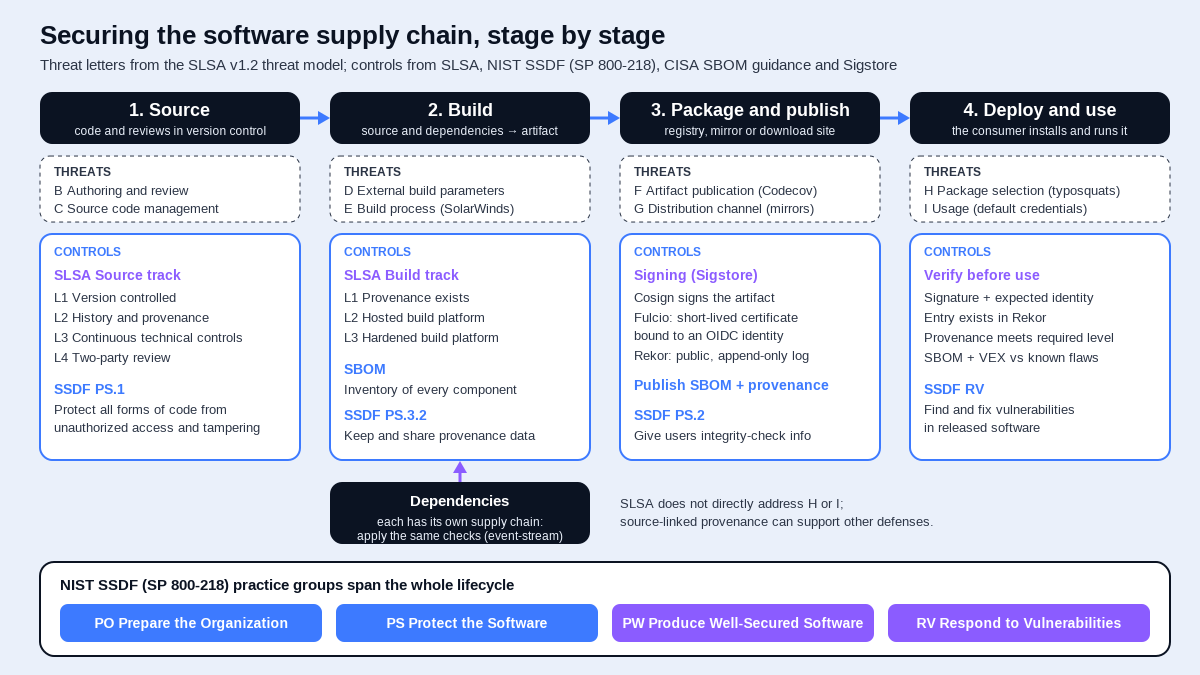
Four public resources do most of the work, and they fit together. SLSA defines levels of build and source integrity. NIST's Secure Software Development Framework (SSDF) describes secure development practices for the whole life cycle. SBOMs list what's inside a piece of software. Sigstore makes signing and verifying artifacts practical. The diagram shows where each one applies.
Where supply chain attacks happen
The SLSA project publishes a threat model that labels each weak point with a letter. It notes that attacks can occur at every link in a typical supply chain, and that SLSA doesn't yet address all of them [5]. Here are the threats SLSA lists, each with the real-world example it cites [5]:
Stage | SLSA threat | Example SLSA cites [5] | What would have helped, per SLSA |
|---|---|---|---|
Producer | A: A malicious producer | SpySheriff (fake anti-spyware) | Not directly addressed; public source makes malice easier to spot |
Source | B: Authoring and reviewing | SushiSwap (malicious commit by a contractor) | Two-person review |
Source | C: Source code management | PHP (self-hosted git server compromised) | A better-protected source control system |
Build | D: External build parameters | The Great Suspender | Provenance showing the real sources |
Build | E: Build process | SolarWinds (code implanted via the build platform) | Stronger build-platform requirements at higher levels |
Publish | F: Artifact publication | Codecov (leaked credentials used to upload a bad artifact) | Provenance showing it wasn't built as expected |
Distribute | G: Distribution channel | Researcher-run registry mirrors that could have served malicious packages | Provenance verification |
Consume | H: Package selection | Browserify typosquatting | Not directly addressed; source-linked provenance supports other defenses |
Consume | I: Usage | Apache Superset default credentials | Not addressed by SLSA |
Dependencies | Recursive A–H | event-stream (malicious binary without matching source) | Applying SLSA to all dependencies |
Two lessons stand out. First, the build system is as sensitive as production, because whatever it outputs gets signed and shipped with your name on it. Second, your dependencies have their own supply chains, and each one inherits all of these threats.
Control 1: SLSA levels for builds and source
SLSA is a specification whose levels "provide increasing supply chain security guarantees" [1]. The current version, v1.2, has two tracks, Build and Source [1]. The Source track is new in v1.2; earlier versions covered only builds [2].
The Build track
Each level adds guarantees about how an artifact was produced [3]:
Level | Name | What it means | Protects against [3] |
|---|---|---|---|
Build L0 | No guarantees | "L0 represents the lack of SLSA" | Nothing |
Build L1 | Provenance exists | The package has provenance showing how it was built, but it is "trivial to bypass or forge" | Mistakes; improves documentation |
Build L2 | Hosted build platform | Signed provenance generated by a hosted build platform; forging it requires an explicit attack | Tampering after the build |
Build L3 | Hardened builds | A hardened build platform; forging provenance requires exploiting a vulnerability | Tampering during the build, including by insiders, compromised credentials and other tenants |
Provenance is the key artifact here: verifiable metadata describing how a package was built, from what sources, by which platform. SLSA recommends standard formats for provenance and for verification summaries, but doesn't require them [1].
The Source track
The Source track protects the code before it's built [4]:
Level | Name | Summary [4] |
|---|---|---|
Source L1 | Version controlled | Source is stored and managed in a modern version control system |
Source L2 | History and provenance | Branch history is continuous, immutable and retained |
Source L3 | Continuous technical controls | The source control system enforces the organization's technical controls on specific named references |
Source L4 | Two-party review | Two trusted persons must review all changes to protected branches |
Source L4 maps directly to threat B: SLSA notes two-person review could have caught the malicious SushiSwap commit [5].
Control 2: NIST's SSDF for the whole life cycle
SLSA focuses on integrity. NIST's Secure Software Development Framework covers secure development more broadly. Version 1.1, published as SP 800-218 in February 2022, organizes its practices into four groups [6]:
Group | NIST's goal [6] | Supply chain examples |
|---|---|---|
Prepare the Organization (PO) | People, processes and technology are ready for secure development | Separate and protect build environments; harden developer endpoints (PO.5) |
Protect the Software (PS) | Protect all components of the software from tampering and unauthorized access | Least-privilege access to code (PS.1); integrity verification info for users (PS.2); keep provenance data, e.g., in an SBOM (PS.3.2) |
Produce Well-Secured Software (PW) | Release software with minimal security vulnerabilities | Verify that acquired commercial, open-source and third-party components meet requirements (PW.4.4) |
Respond to Vulnerabilities (RV) | Find residual vulnerabilities and fix them, and prevent recurrences | Gather vulnerability reports on your software and its third-party components (RV.1) |
PS.2 and PS.3 are where SSDF and the other tools meet. PS.2 asks producers to make integrity verification information available, for example by posting cryptographic hashes for release files and using code signing that consumers' tools can validate [6]. PS.3.2 asks them to "collect, safeguard, maintain, and share provenance data for all components of each software release (e.g., in a software bill of materials [SBOM])" [6].
An update is in progress. NIST released SSDF version 1.2 (SP 800-218 Rev. 1) as an initial public draft on December 17, 2025, with comments closing January 30, 2026 [7]. As of November 2026, the NIST page we reviewed still listed it as a draft, so version 1.1 remains the final standard [7].
Control 3: SBOMs, the ingredients list
CISA describes an SBOM as "a nested inventory, a list of ingredients that make up software components" [8]. When a vulnerability is announced in a widely used library, an SBOM is what lets you answer "are we affected, and where?" without auditing every system by hand.
The U.S. baseline changed this year. On July 29, 2026, CISA, the NSA, the FBI and international partners published the 2026 Minimum Elements for a Software Bill of Materials, building on the NTIA's 2021 minimum elements and on feedback from a 2025 public comment period [9][10]. According to CISA's announcement, the update [10]:
- Refines the baseline data fields, adding requirements for component hash, license, SBOM tool name and SBOM generation context.
- Enhances practices for documenting and sharing software components.
- Updates guidance to cover open source, AI and software-as-a-service.
- Emphasizes machine-processable SBOM formats.
SBOMs pair with VEX (Vulnerability Exploitability eXchange) documents. CISA describes VEX as an attestation, a form of security advisory that indicates whether a product is affected by a known vulnerability [8]. An SBOM tells you a vulnerable component is present; VEX tells you whether it actually matters in that product.
Control 4: signing with Sigstore
Signing proves who produced an artifact and that it hasn't changed since. Sigstore, an open source project for improving software supply chain security, is built so developers don't have to manage long-lived signing keys [11]:
- Ephemeral keys. The Cosign client generates a temporary key pair for a single signing, so there's "no need to manage keys" [11].
- Identity-based certificates. Cosign sends the public key and an OpenID Connect (OIDC) identity token, such as a developer's email, a service account or CI workflow identity, to Fulcio, Sigstore's certificate authority. Fulcio verifies the token and issues a short-lived certificate bound to that identity [11].
- Discarded private key. The private key is thrown away after signing; Sigstore services never obtain it [11].
- Public transparency log. The artifact's digest, signature and certificate are recorded in Rekor, an immutable, append-only ledger. Anyone can audit it, and identity owners can watch for misuse of their identity [11].
Verification checks four things: the signature is valid, the certificate's identity matches the one you expect, the certificate chains to Sigstore's root of trust, and the signing event appears in Rekor [11]. Sigstore can sign release files, container images and SBOMs [11].
Putting it together: controls at each stage
Stage | Main threats [5] | Controls |
|---|---|---|
Source | B, C | SLSA Source L1–L4 [4]; SSDF PS.1 least-privilege access to code [6] |
Build | D, E | SLSA Build L2–L3 with signed provenance [3]; generate an SBOM [8]; SSDF PS.3.2 [6]; isolate build environments (SSDF PO.5) [6] |
Dependencies | Recursive A–H | Verify third-party components (SSDF PW.4.4) [6]; require provenance and SBOMs from suppliers [6][9] |
Package and publish | F, G | Sign artifacts and SBOMs with Sigstore [11]; publish integrity info (SSDF PS.2) [6] |
Deploy and use | H, I | Verify signature, identity and Rekor entry [11]; check provenance against required SLSA level [3]; use SBOM and VEX to triage vulnerabilities [8]; respond (SSDF RV) [6] |
Supply chain controls also connect to broader architecture. Container images and Kubernetes deployments are common places to enforce verification; see our explainers on containers vs virtual machines, Kubernetes architecture and infrastructure as code. Build systems run on credentials, so identity and access management and zero trust principles apply to pipelines as much as to people. AI tooling adds new dependencies too; see AI agent security and governance.
Limitations
- SLSA doesn't cover everything. It doesn't directly address malicious producers, typosquatted package names, insecure usage such as default credentials, or package availability [5].
- Provenance only helps if someone checks it. Signed metadata that no one verifies at deploy time doesn't stop anything.
- An SBOM is only as good as its accuracy. A list that misses components gives false comfort. CISA's updated baseline adds fields for the SBOM tool name and generation context [10], which tell consumers how the SBOM was made.
- Identity is the new key. With keyless signing, the security of a signature depends on the OIDC identity behind it [11], so protecting CI and developer accounts becomes critical.
- Standards are moving. SLSA added its Source track in v1.2 [2], CISA's SBOM baseline changed in July 2026 [10], and SSDF 1.2 is still a draft [7].
How to start
- Inventory. Generate SBOMs for what you build and request them for what you buy [8][9].
- Get to SLSA Build L2. Build on a hosted platform that produces signed provenance [3].
- Sign releases. Sign artifacts, and verify signatures and identities before deploy [11].
- Protect source. Enforce branch protections, and two-party review for critical repos (Source L4) [4].
- Map to SSDF. Use the four practice groups to find gaps in the rest of your development process [6].
- Plan for response. Use SBOMs and VEX to answer "are we affected?" quickly when a vulnerability lands [8], and route incidents to your security operations center.
Frequently asked questions
What is a software supply chain attack?
An attack that compromises software through something its users trust, such as a source repository, build system, package registry or dependency, rather than attacking the target directly. SLSA's threat model lists attacks at every stage, including the SolarWinds build compromise and the Codecov artifact upload [5].
What is the difference between SLSA and an SBOM?
An SBOM lists what's inside software [8]. SLSA provenance describes how and where it was built and whether that process could have been tampered with [1][3]. They answer different questions and work best together.
What is SLSA Build Level 3?
The highest SLSA Build level. It requires a hardened build platform, so forging provenance would require exploiting a vulnerability, and it protects against tampering during the build [3].
What changed in CISA's 2026 SBOM minimum elements?
Published July 29, 2026, the update adds required fields for component hash, license, SBOM tool name and SBOM generation context, extends guidance to open source, AI and SaaS software, and emphasizes machine-processable formats [10].
How does Sigstore keyless signing work?
The signer's client creates a one-time key pair, proves its identity with an OIDC token, gets a short-lived certificate from Fulcio and records the signature in the Rekor transparency log; the private key is then discarded [11].
Is the NIST SSDF mandatory?
The SSDF itself is a set of recommended practices [6]. Whether it's required depends on your contracts and customers; NIST notes that software acquirers can use it in acquisition processes and communications with suppliers [7].
Sources
- SLSA, "SLSA specification v1.2." https://slsa.dev/spec/v1.2/
- SLSA, "What's new in v1.2." https://slsa.dev/spec/v1.2/whats-new
- SLSA, "Build Track Basics" (v1.2). https://slsa.dev/spec/v1.2/build-track-basics
- SLSA, "Source Track requirements" (v1.2). https://slsa.dev/spec/v1.2/source-requirements
- SLSA, "Threats overview" (v1.2). https://slsa.dev/spec/v1.2/threats-overview
- NIST, "SP 800-218, Secure Software Development Framework (SSDF) Version 1.1," February 2022. https://nvlpubs.nist.gov/nistpubs/SpecialPublications/NIST.SP.800-218.pdf
- NIST, "SP 800-218 Rev. 1 (Initial Public Draft), Secure Software Development Framework (SSDF) Version 1.2," December 17, 2025. https://csrc.nist.gov/pubs/sp/800/218/r1/ipd
- CISA, "Software Bill of Materials (SBOM)." https://www.cisa.gov/sbom
- CISA, "2026 Minimum Elements for a Software Bill of Materials (SBOM)," July 29, 2026. https://www.cisa.gov/resources-tools/resources/2026-minimum-elements-software-bill-materials-sbom
- CISA, "CISA, U.S. Government and International Partners Release Updated Minimum Elements for a Software Bill of Materials," bulletin, July 29, 2026. https://content.govdelivery.com/accounts/USDHSCISA/bulletins/422a7eb
- Sigstore, "Overview." https://docs.sigstore.dev/about/overview/