The AI Semiconductor Market Explained: Who Makes What
How the AI chip market works in 2026: GPUs and custom accelerators, the HBM memory boom, foundries, packaging and export rules, with WSTS and SIA data.
The AI semiconductor market is the set of companies and products that supply the chips behind artificial intelligence: accelerators such as GPUs and custom AI chips, the high-bandwidth memory that feeds them, the foundries that manufacture them, the packaging that combines them, and the equipment makers behind all of it. In 2026, AI demand is the main force driving the whole chip industry. WSTS, the industry's statistics body, forecasts the global semiconductor market will grow about 90% in 2026 to $1.51 trillion, led overwhelmingly by memory [1].
For the technical differences between chip types, see our AI chips vs CPUs vs GPUs vs TPUs guide. This article is about the market.
The scale of the boom (as of November 2026)
The numbers are unlike anything in the industry's history:
- Global sales: The Semiconductor Industry Association (SIA) reported $517.7 billion in global semiconductor sales in the third quarter of 2026, up 24.1% from the second quarter. September sales, measured as a three-month moving average, were $172.6 billion, up 146.8% from September 2025 [2].
- Forecast: WSTS's spring 2026 forecast, published June 2, 2026, projects $1.51 trillion for 2026 and about $1.9 trillion in 2027, a further 27% rise [1].
- Memory leads: WSTS forecasts memory revenue to surge by around 250% in 2026 to more than $800 billion, citing AI infrastructure and high-bandwidth memory (HBM) demand [1]. Logic chips are forecast to grow 37% [1].
- Regions: In September, year-over-year sales were up most in the Americas (191.7%), followed by Asia Pacific/All Other, China, Europe and Japan [2].
How the AI chip value chain fits together
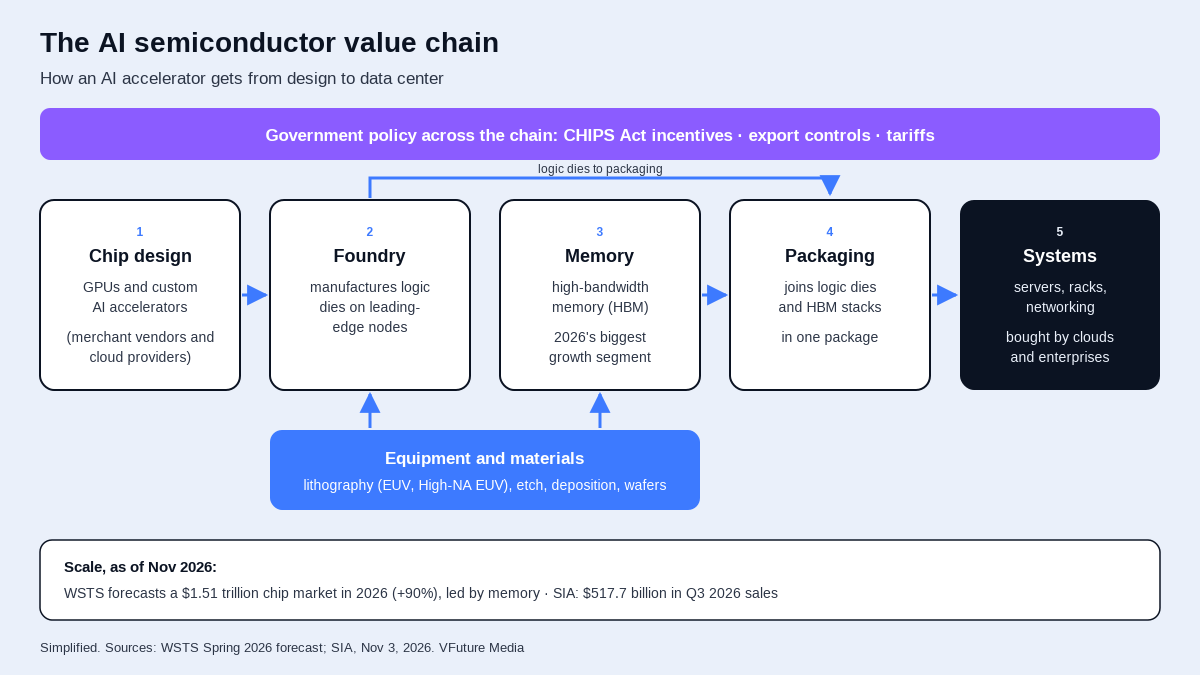
An AI server is the product of several specialized industries (see the diagram).
Layer | What it supplies | Why it matters for AI |
|---|---|---|
Accelerator design | GPUs and custom AI chips (ASICs) | Where AI math happens |
Memory | High-bandwidth memory (HBM) stacked next to the accelerator | AI performance is often limited by memory bandwidth |
Foundry | Manufacturing of the logic dies on leading-edge nodes | Only a few companies can make the most advanced chips |
Advanced packaging | Combining logic dies and HBM in one package | Today's largest AI chips are multi-die packages |
Equipment and materials | Lithography, deposition, etch, wafers, chemicals | Sets the pace of new nodes |
Systems | Servers, racks, networking | What cloud providers and enterprises actually buy |
Accelerators
NVIDIA dominates AI accelerators. For its fiscal third quarter ended October 25, 2026, it reported revenue of $115.8 billion, up 103% from a year earlier, of which data center revenue was $107.6 billion, up 110% [3]. NVIDIA also said its Vera Rubin NVL72 rack-scale platform has shipped [3].
Competition comes from two directions. AMD sells Instinct accelerators; its MI300X, for example, packs 192 GB of HBM3 [7]. And the largest cloud providers design their own custom accelerators to reduce dependence on a single supplier and tune chips to their workloads. Our AI chips guide explains how TPUs and other ASICs differ from GPUs, and our upcoming GPU architecture explainer looks inside the chips.
Memory: the surprise winner
The biggest shift of 2026 is in memory. AI accelerators need enormous memory bandwidth, supplied by HBM, which stacks DRAM dies vertically beside the processor. WSTS attributes the forecast memory surge to AI infrastructure and HBM demand [1].
Foundries
TSMC, the foundry behind many leading AI chips, shows how much of its business AI now drives. In the third quarter of 2026, high-performance computing, the category that includes AI accelerators, made up 68% of TSMC's net revenue, and processes at 7nm and below made up 79% of wafer revenue [10][4]. TSMC's CEO said AI demand still exceeds supply [4]. Its 2nm node, which entered high-volume manufacturing in the fourth quarter of 2025, reached 8% of wafer revenue [10], and TSMC expects 2nm-family capacity to more than double in 2027 [4].
Packaging and equipment
Advanced packaging joins logic dies and HBM stacks in one package; TSMC says it is already producing advanced packages at five times the reticle size [4]. See our upcoming advanced packaging explainer. Equipment makers sit further upstream. ASML's newest High-NA EUV lithography machines cost about $400 million each, as reported by The Next Web [8]. Our upcoming future of semiconductor technology piece covers where manufacturing technology is heading.
Policy: subsidies and export controls
Governments treat AI chips as strategic.
Subsidies. The US CHIPS and Science Act of 2022 gave the Commerce Department $50 billion: $39 billion for manufacturing incentives and $11 billion for research and development [6]. Awards are still being signed and adjusted in 2026 [6].
Export controls. The US restricts sales of advanced AI chips to China. In January 2026, the Bureau of Industry and Security changed its approach for one tier of chips. It now reviews license applications for the NVIDIA H200, AMD MI325X and similar chips case by case, rather than presuming denial, provided security conditions are met [5][9]. Those conditions include customer screening and independent third-party testing in the United States [5]. The rule followed a December 8, 2025 presidential announcement allowing the H200 to be shipped to approved Chinese customers [5]. The Federal Register rule keeps all other applications to China, including for more powerful chips, under a presumption of denial [9]. In November 2026, an interim final rule added restrictions on exports to overseas data centers that remotely supply significant compute to companies headquartered in China and other countries of concern, and a license requirement for advanced chips going to Indonesia, Malaysia, Singapore, Thailand and Brazil [11]. Export policy can change quickly, and it directly affects how much of the Chinese market US chipmakers can serve.
Why demand is so strong
The core driver is spending on AI data centers by cloud providers, AI labs and enterprises. Training frontier models takes huge GPU clusters, and running AI services for millions of users (inference) needs even more capacity over time. Our explainer on AI training vs inference explains the difference. The energy side of the build-out is covered in our upcoming AI data centers and energy explainer.
Risks and debates
- Is it a bubble? Growth on this scale has prompted debate about whether AI spending can keep rising (see our coverage of AI bubble fears). The chip industry has a long history of boom-and-bust cycles, especially in memory.
- Concentration. A single company's data center revenue exceeds $100 billion a quarter [3], and leading-edge manufacturing is concentrated in a handful of foundries. Disruption at any key supplier would ripple through the market.
- Supply bottlenecks. TSMC says AI demand remains far above what it can currently supply [4]. Any shortfall in memory, packaging or leading-edge wafer capacity limits how many accelerators can ship.
- Policy risk. Export rules [5], tariffs and subsidies can change suddenly.
- Power. Data center electricity and cooling may cap how fast new capacity can be used.
How to read the market
- Watch memory as closely as GPUs. In 2026, memory is the largest growth engine [1].
- Use primary data. SIA publishes monthly sales figures based on WSTS data, and WSTS publishes periodic market forecasts [1][2]. Company results are the best evidence of real demand.
- Separate forecasts from results. A forecast like WSTS's $1.9 trillion for 2027 [1] is a projection that will be revised.
- Follow the bottlenecks. Capacity announcements for HBM, packaging and 2nm-class wafers often signal where the market goes next.
Outlook
On current forecasts, the market keeps growing strongly into 2027, with memory again leading [1]. Expect continued competition between merchant GPUs and custom cloud chips, more capacity for HBM and advanced packaging, and leading-edge manufacturing expanding in the US [4][6]. The big unknown is whether AI spending keeps compounding. WSTS revises its forecasts (its spring 2026 update significantly raised the outlook [1]), so treat any single projection as provisional.
Frequently asked questions
How big is the AI semiconductor market?
There's no single official figure for "AI chips," but AI is driving the whole industry. WSTS forecasts total semiconductor sales of $1.51 trillion in 2026, up about 90%, with memory for AI infrastructure the biggest driver [1]. NVIDIA alone reported $107.6 billion in data center revenue for one quarter [3].
Why is memory growing so fast?
AI accelerators need huge memory bandwidth, supplied by high-bandwidth memory stacked beside the chip. WSTS forecasts memory revenue to rise around 250% in 2026 to more than $800 billion, citing AI infrastructure and HBM demand [1].
Who manufactures AI chips?
Companies like NVIDIA and AMD design them, and cloud providers design custom ones. Manufacturing is done by foundries, led at the leading edge by TSMC, where high-performance computing made up 68% of third-quarter 2026 net revenue [10].
Can NVIDIA sell AI chips to China?
Under a January 2026 US rule, licenses for the H200 and similar chips to China are reviewed case by case if security conditions are met, including third-party testing in the US [5][9]. Other applications remain under a presumption of denial [9], and policy can change.
Is the AI chip boom a bubble?
Nobody knows. Current company results and industry data show very strong demand [2][3][4], and forecasts call for further growth in 2027 [1], but the chip industry is historically cyclical and depends on continued AI spending.
What is the CHIPS Act?
A 2022 US law that gave the Commerce Department $50 billion to strengthen domestic chipmaking: $39 billion for manufacturing incentives and $11 billion for R&D [6].
Sources
- World Semiconductor Trade Statistics (WSTS), "Semiconductor Market Forecast Spring 2026," June 2, 2026. https://www.wsts.org/esraCMS/extension/media/f/WST/7618/WSTS_FC-Release-2026-May.pdf
- Semiconductor Industry Association, "Global Semiconductor Sales Increase 24.1% from Q2 2026 to Q3 2026," November 3, 2026. https://www.semiconductors.org/global-semiconductor-sales-increase-24-1-from-q2-2026-to-q3-2026/
- NVIDIA, "NVIDIA Announces Financial Results for Third Quarter Fiscal 2027," November 17, 2026 (company-reported results). https://investor.nvidia.com/news/press-release-details/2026/NVIDIA-Announces-Financial-Results-for-Third-Quarter-Fiscal-2027/default.aspx
- CRN Asia, "TSMC third quarter revenue tops guidance as CEO says AI demand still exceeds supply," October 2026 (reporting TSMC results). https://www.crnasia.com/news/2026/components-and-peripherals/tsmc-third-quarter-revenue-tops-guidance-as-ceo-says-ai-dema
- Bureau of Industry and Security, US Department of Commerce, "Department of Commerce Revises License Review Policy for Semiconductors Exported to China," January 2026. https://bis.gov/press-release/department-commerce-revises-license-review-policy-semiconductors-exported-china
- NIST, "CHIPS for America." https://www.nist.gov/chips
- AMD, "AMD CDNA 3 Architecture White Paper" (vendor documentation). https://www.amd.com/content/dam/amd/en/documents/instinct-tech-docs/white-papers/amd-cdna-3-white-paper.pdf
- The Next Web, "ASML's $400M chipmaking machine just shipped its first laptop processors," 2026. https://thenextweb.com/news/intel-asml-high-na-euv-panther-lake-laptop-chips
- Bureau of Industry and Security, "Revision to License Review Policy for Advanced Computing Commodities," final rule, Federal Register Vol. 91, No. 10, January 15, 2026 (FR Doc. 2026-00789). https://www.govinfo.gov/content/pkg/FR-2026-01-15/pdf/2026-00789.pdf
- TSMC, "3Q26 Management Report," October 15, 2026 (Wayback Machine copy). http://web.archive.org/web/20261117112852/https://investor.tsmc.com/english/encrypt/files/encrypt_file/reports/2026-10/f83780000ddc0c3b48e57a87eab6814c4ab35058/3Q26%20ManagementReport.pdf
- Bureau of Industry and Security, "Addressing Remote Access to Advanced Semiconductors," interim final rule, 91 FR 74970, November 19, 2026 (FR Doc. 2026-23529). https://www.federalregister.gov/documents/2026/11/19/2026-23529/addressing-remote-access-to-advanced-semiconductors