EV Charging Standards in the United States: The Full Stack Explained
US EV charging standards layer by layer: J1772, CCS1, J3400 and MCS plugs; ISO 15118, OCPP and OCPI protocols; UL safety, NIST metering and NEVI rules.
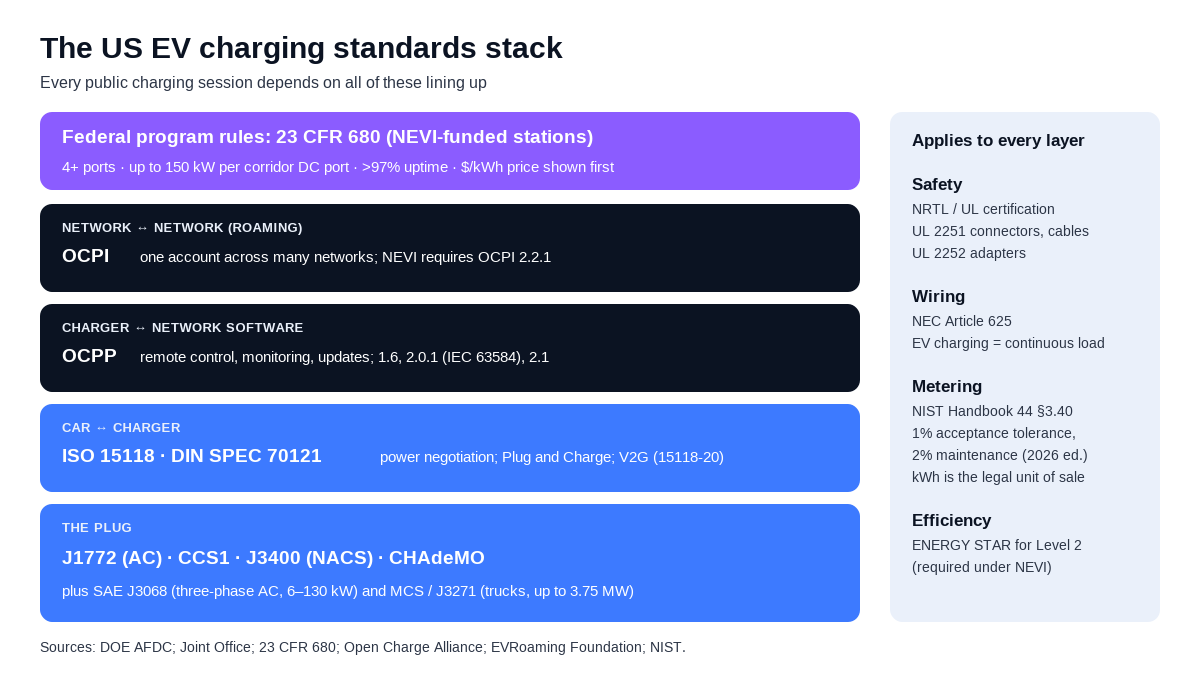
US EV charging runs on a stack of standards, not one. SAE connector standards (J1772, CCS1 and J3400) define the plug. ISO 15118 and DIN SPEC 70121 define how the car and charger talk. OCPP connects the charger to its network's software, and OCPI lets networks roam with each other [1][3][4]. Around those sit UL safety certification, the National Electrical Code, NIST rules for metering electricity sold by the kWh, and, for federally funded stations, the NEVI requirements in 23 CFR 680 [1][4][7].
Each layer solves a different problem. When charging fails, it's often a mismatch at one layer, not a missing plug. This guide goes through the stack from the bottom up.
Layer 1: the plug (physical connectors)
Standard | What it's for | Notes (as of late 2026) |
|---|---|---|
SAE J1772 | AC Level 1 and Level 2 | The long-standing AC plug; every commercially available US EV can use Level 1 and Level 2 [1] |
CCS1 (SAE J1772 combo) | AC plus DC fast | The J1772 layout with two extra DC pins; most EV models on the market can charge with it [1] |
SAE J3400 (NACS) | AC and DC in one compact plug | Tesla's design, standardized by SAE; the same two contacts carry AC or DC [2][10] |
CHAdeMO | DC fast | Mainly used by Japanese automakers [1] |
SAE J3068 | Higher-power three-phase AC | Developed in 2018 for three-phase power at commercial and industrial sites; targets 6 kW to 130 kW [1] |
MCS / SAE J3271 | Heavy-duty trucks | Megawatt Charging System, described by AFDC as DC charging up to 3.75 MW; SAE issued J3271 as a Technical Information Report in March 2025 [1][11] |
The big story at this layer is the switch from CCS1 to J3400. SAE published J3400 as a Technical Information Report in December 2023 and as a Recommended Practice in September 2024 [2][10]. Most automakers committed to J3400 ports beginning in 2025, while every non-Tesla EV built through 2024 kept a CCS1 port [2]. We cover the switch in detail in Tesla NACS vs CCS.
Layer 2: the car-to-charger conversation
Plugging in starts a digital conversation. The car and charger exchange information about what the car can accept and what the charger can supply, and power delivery follows the car's requests. NEVI's power rule, for instance, is written in terms of supplying power "according to an EV's power delivery request" [4]. For DC fast charging this happens over standardized protocols:
- ISO 15118. NEVI requires federally funded chargers to conform to ISO 15118-3 and to have hardware that can run both ISO 15118-2 and ISO 15118-20. Their software must conform to ISO 15118-2 and be capable of Plug and Charge [4]. Plug and Charge authenticates the driver through ISO 15118 digital certificates when you plug in, then starts the session and handles payment automatically, with no app or card [4].
- DIN SPEC 70121. This is the earlier DC charging communication standard. CharIN's North America Charging Interoperability task force works to keep charging connector-agnostic under ISO 15118 and DIN SPEC 70121. The aim is that a J3400 car and a CCS1 car use the same communication rules, whatever the plug [3].
Bidirectional charging (vehicle-to-grid) depends on this layer too. ISO 15118-20 carries the messages for it, and OCPP 2.1 adds support for ISO 15118-20 with bidirectional power transfer [5]. For the bigger picture on using EVs as grid batteries, see our explainer on vehicle-to-grid technology.
Layer 3: charger-to-network (OCPP)
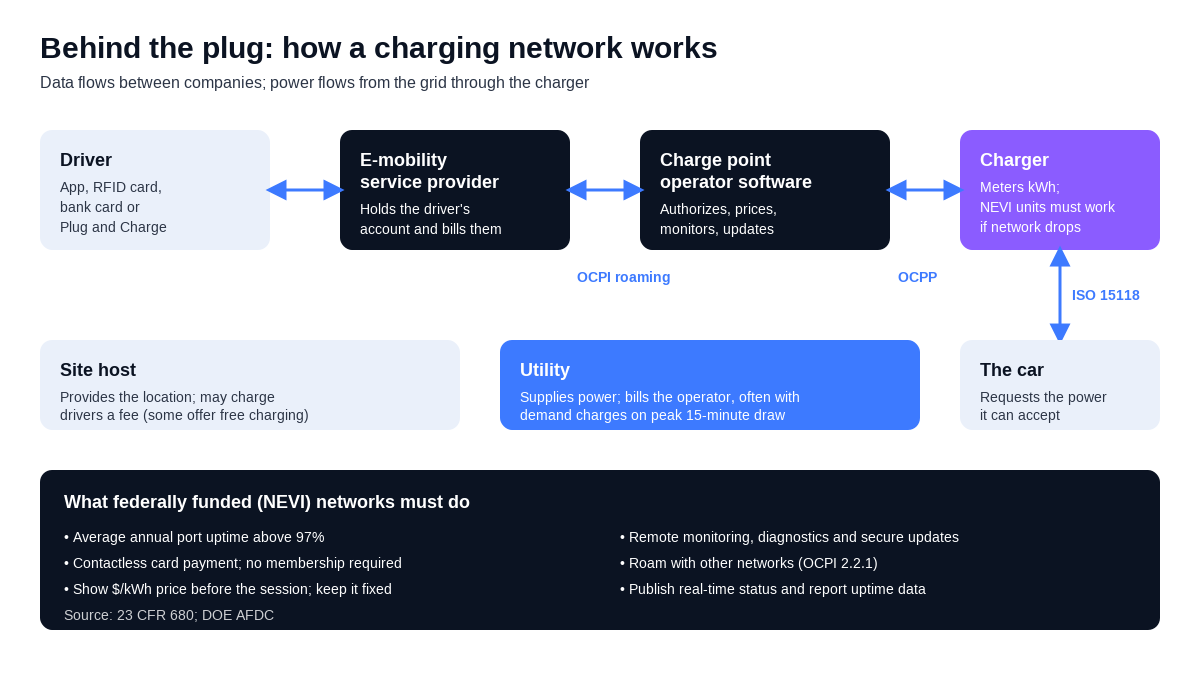
Public chargers are networked computers. The Open Charge Point Protocol (OCPP) is the open protocol between a charging station and the management system that runs it remotely [5]. Through OCPP, an operator can start and stop sessions, push software updates, monitor faults and manage power across a site.
- Versions. OCPP 1.6 is still widely used. OCPP 2.0.1 was released in 2020, and an edition of it was approved as international standard IEC 63584 in 2024. OCPP 2.1 adds bidirectional charging, distributed energy resource control and improved smart charging [5].
- Federal requirement. NEVI-funded chargers had to move to OCPP 2.0.1 by February 28, 2024 [4].
Because OCPP is open, a site host can in principle switch network software without replacing hardware. Without it, each charger is locked to its maker's proprietary system.
Layer 4: network-to-network roaming (OCPI)
Drivers don't want a separate app for every charging company. The Open Charge Point Interface (OCPI) connects charge point operators, who run stations, with e-mobility service providers, who have drivers as customers. The goal is real-time prices, locations, availability and a single invoice across networks [6], and NEVI requires networks to let a driver use a single method of identification across multiple networks [4].
- NEVI requires networks to be able to communicate with other networks using OCPI 2.2.1 [4].
- The EVRoaming Foundation, which maintains OCPI, lists version 2.3.0 as current, with OCPI 3.0 in draft and a target release in mid-2027 [6].
AFDC's Station Locator uses OCPI's terminology. A station location has one or more ports, and each port can have several connectors but charges only one vehicle at a time [1].
Layer 5: safety, wiring and metering
Electrical safety. NEVI requires all chargers to be certified by an OSHA Nationally Recognized Testing Laboratory, and AC Level 2 chargers to be ENERGY STAR certified [4]. J3400 connectors and cables need UL 2251 certification, and UL 2252 is the standard for adapters [2][3]. UL has since published UL 2252, and CharIN said in April 2025 that manufacturers can already certify adapters to it [12]. The Joint Office's adapter page still tells drivers to use only automaker-provided adapters "until UL 2252 certified adapters become available" (as of November 2026) [3], so look for UL 2252 certification and check your automaker's guidance before buying one.
Wiring. The National Electrical Code treats EV charging as a continuous load, and NEC Article 625 contains most of the rules for charging equipment [9]. AFDC notes that a typical 30-amp home Level 2 unit needs a dedicated 40-amp circuit under Article 625 [1]. Local permits may be required [9].
Metering: are you getting the kWh you pay for? This is legal metrology, run by state weights-and-measures programs using NIST model codes:
- NIST Handbook 130 makes the kilowatt-hour the official unit for selling electricity as a vehicle fuel [8].
- NIST Handbook 44, Section 3.40 sets accuracy rules for commercial chargers. Its status changed from tentative to permanent on January 1, 2023 [7]. In the 2026 edition, AC chargers have a 1.0% acceptance tolerance and a 2.0% maintenance tolerance [7]. DC chargers get the same 1%/2% tolerances, except older DC units in service before January 1, 2025 and marked Class 5, which have a 5% tolerance that expires on January 1, 2034. DC units placed in service before January 1, 2025 are also exempt from the DC tolerance requirement until January 1, 2028 [7].
- If you think a public charger overbilled you, NIST points drivers to their state weights-and-measures program [8].
Pricing methods still vary by state: per kWh, by time connected, flat session fees, plus parking or membership fees [8].
Layer 6: federal program rules (NEVI, 23 CFR 680)
For stations built with National Electric Vehicle Infrastructure (NEVI) formula funds or other Title 23 money, 23 CFR 680 pulls the layers together into enforceable minimums [4]:
Requirement | What 23 CFR 680 says |
|---|---|
Ports | At least four network-connected ports that can charge four EVs at once [4] |
Connectors | Every DC port must charge any CCS-compliant vehicle with a permanently attached CCS1 connector; Level 2 ports need J1772 [4] |
Power | All DC ports: 250–920 V DC output; corridor DC ports: up to 150 kW each at the same time; Level 2 ports: at least 6 kW [4] |
Uptime | Average annual port uptime above 97% [4] |
Payment | Contactless debit/credit card plus an automated toll-free phone or SMS option; no membership required [4] |
Pricing | Price shown in $/kWh before the session and fixed once it starts [4] |
Protocols | ISO 15118, OCPP 2.0.1 and OCPI 2.2.1 as described above [4] |
Resilience | Chargers must keep working if the network connection drops [4] |
Workforce | Electricians need Electric Vehicle Infrastructure Training Program (EVITP) certification or a qualifying registered-apprenticeship credential [4] |
Stewardship | Chargers must be kept compliant for at least 5 years from opening [4] |
Data | Session, uptime, outage and maintenance-cost data must be reported to FHWA [4] |
Two clarifications. These rules apply to federally funded projects, not every charger in the country. And as of November 2026, eCFR still shows the February 2023 rule (88 FR 12752) as current [4]. The Joint Office says federally funded chargers can include a J3400 connector if there is also a CCS1 connector, and that adapters should be permanently attached and integrated by the charger manufacturer [2].
Why the stack matters to drivers
Most frustrating charging experiences map onto one of these layers:
- "My car won't start charging." Often a communication-layer problem: the car and charger failing to complete their handshake. Industry interoperability work under ISO 15118 targets exactly this [3].
- "The app says available but it's broken." A network-layer (OCPP) monitoring problem. NEVI's uptime and status-reporting rules exist because of it [4].
- "I need three apps." A roaming-layer (OCPI) gap [6].
- "Did I get what I paid for?" A metering question for NIST Handbook 44 and your state inspectors [7][8].
For how networks run day to day, from pricing to uptime, see our explainer on how EV charging networks work.
Frequently asked questions
What is the main EV charging standard in the US?
There isn't just one. For plugs, J1772 handles AC charging and CCS1 has been the main DC fast standard, with most automakers committing to SAE J3400 (NACS) ports beginning in 2025 [1][2]. Behind the plug, ISO 15118, OCPP and OCPI govern communication [4].
What is Plug and Charge?
Plug and Charge, built on ISO 15118, lets the car identify itself to the charger and handle authorization and payment automatically when you plug in. NEVI-funded chargers must support it [4].
What's the difference between OCPP and OCPI?
OCPP connects a charging station to its operator's management software [5]. OCPI connects different companies' networks so a driver can use one account across networks [6].
Are public chargers checked for accuracy?
Yes, through state weights-and-measures programs using NIST Handbook 44. In the 2026 edition, most commercial chargers must meet a 1% acceptance and 2% maintenance tolerance, with a temporary 5% tolerance for some older DC units [7][8].
Do NEVI rules apply to Tesla Superchargers?
NEVI rules apply to stations built with NEVI or other Title 23 federal funds [4]. Privately funded stations aren't bound by 23 CFR 680, though they're still subject to electrical codes, permits and state weights-and-measures rules [4][8][9].
Sources
- U.S. Department of Energy, Alternative Fuels Data Center. "Developing Infrastructure to Charge Electric Vehicles." https://afdc.energy.gov/fuels/electricity-stations
- Joint Office of Energy and Transportation. "SAE J3400 Charging Connector." https://driveelectric.gov/charging-connector
- Joint Office of Energy and Transportation. "Electric Vehicle Charging Connector and Adapter Compatibility." https://driveelectric.gov/adapter-compatibility
- Federal Highway Administration. 23 CFR Part 680, "National Electric Vehicle Infrastructure Standards and Requirements" (88 FR 12752, Feb. 28, 2023), via eCFR. https://www.ecfr.gov/current/title-23/chapter-I/subchapter-G/part-680
- Open Charge Alliance. "Open Charge Point Protocol." https://openchargealliance.org/protocols/open-charge-point-protocol/
- EVRoaming Foundation. "OCPI: Open Charge Point Interface." https://evroaming.org/ocpi/
- National Institute of Standards and Technology. NIST Handbook 44 (2026), Section 3.40, "Electric Vehicle Fueling Systems." https://www.nist.gov/document/2026-nist-handbook-44-section-340
- National Institute of Standards and Technology, Office of Weights and Measures. "Electric Vehicle Fueling FAQs." https://www.nist.gov/pml/owm/electric-vehicle-fueling-faqs
- U.S. Department of Energy, Alternative Fuels Data Center. "Charging Electric Vehicles at Home." https://afdc.energy.gov/fuels/electricity-charging-home
- SAE International. "J3400_202409: North American Charging System (NACS) for Electric Vehicles." https://saemobilus.sae.org/standards/j3400_202409-north-american-charging-system-nacs-electric-vehicles
- SAE International. "J3271_202503: SAE Megawatt Charging System for Electric Vehicles" (Technical Information Report, March 2025). https://saemobilus.sae.org/standards/j3271_202503-sae-megawatt-charging-system-electric-vehicles
- CharIN. "Updated Statement Regarding SAE J3400/SAE J1772 Adapters" (April 15, 2025). https://www.charin.global/news/updated-statement-sae-j3400-adapters/