How Electric Vehicles Work: From the Plug to the Wheels
How an electric car works, part by part: charge port, onboard charger, battery, inverter, motor and regenerative braking, plus where the energy really goes.
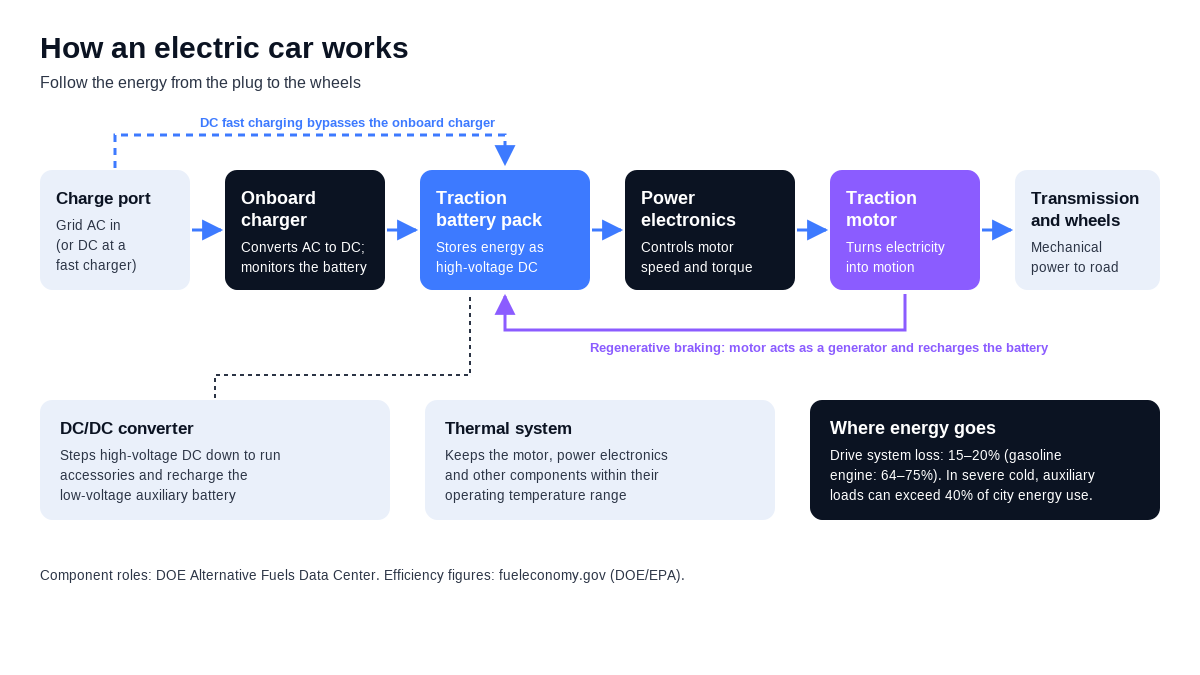
An electric vehicle stores energy as DC electricity in a large traction battery. A power electronics controller meters that energy out to an electric motor, which turns the wheels through a simple transmission [1]. There's no engine, fuel tank or exhaust. When you slow down, the motor runs in reverse as a generator and puts some energy back into the battery [1][3]. This design wastes far less energy than a gasoline engine: the electric drive system accounts for a 15% to 20% energy loss, compared with 64% to 75% for a gasoline engine [3].
This guide follows the energy from the plug to the tires. If you're shopping rather than studying, our beginner's guide to electric vehicles covers range, costs and buying decisions.
The main parts, in the order energy flows
The Alternative Fuels Data Center lists the key components of an all-electric car [1]. Here they are in the order the energy reaches them.
1. Charge port
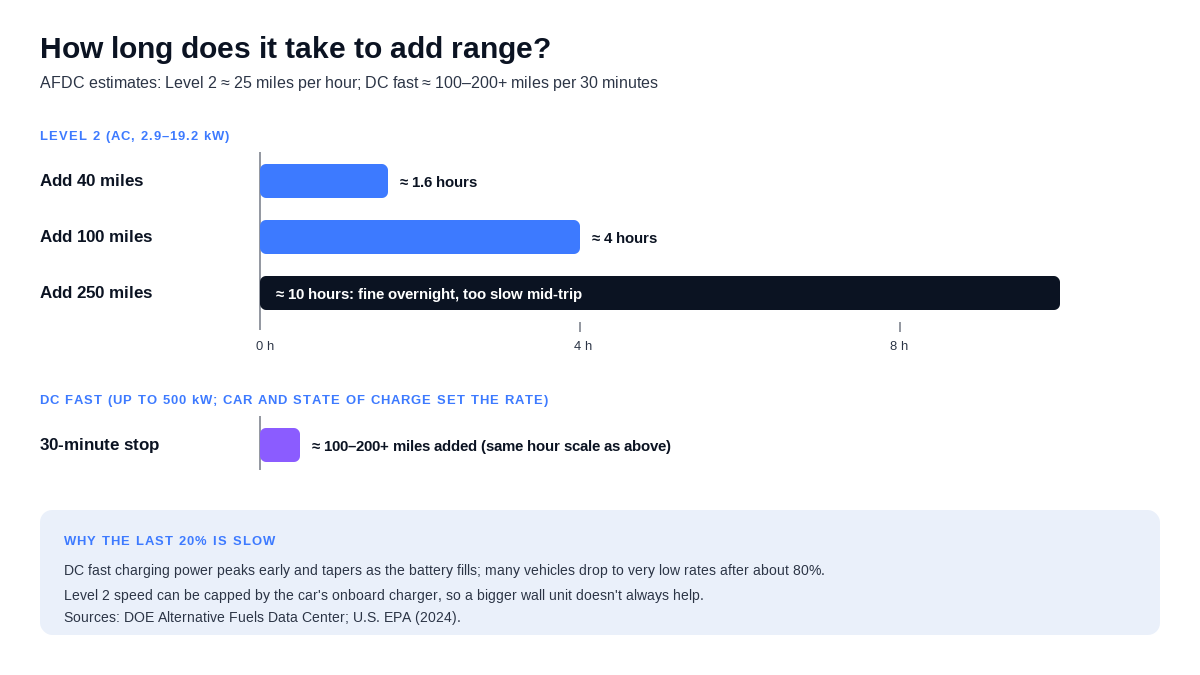
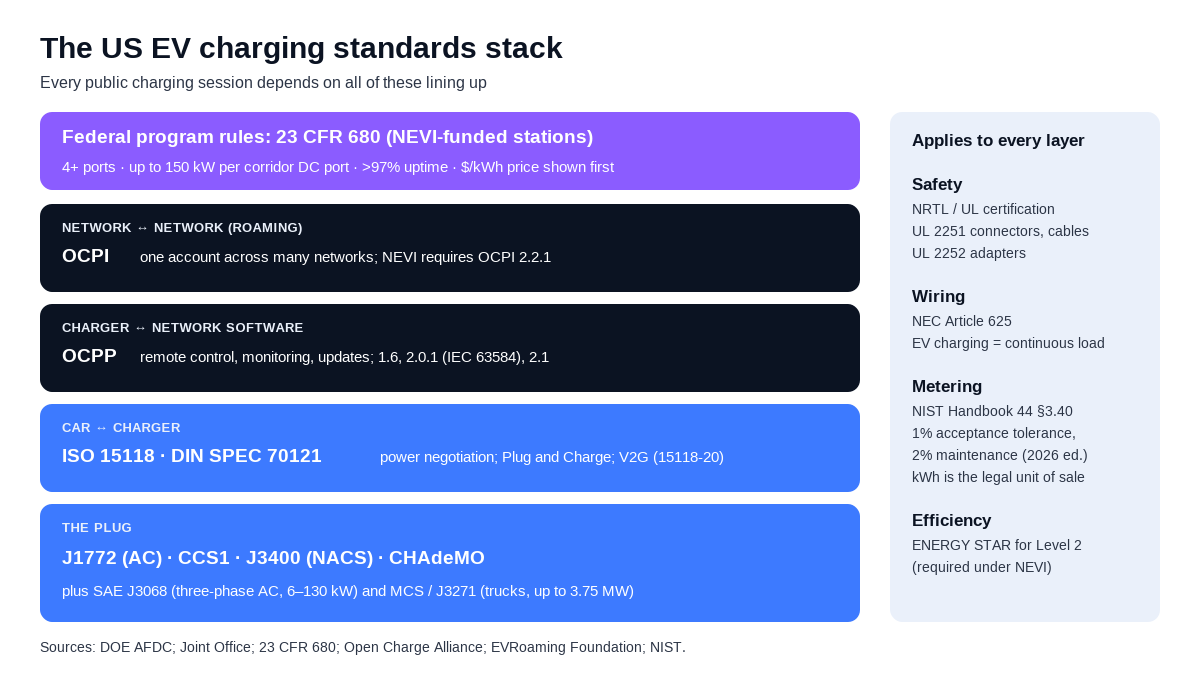
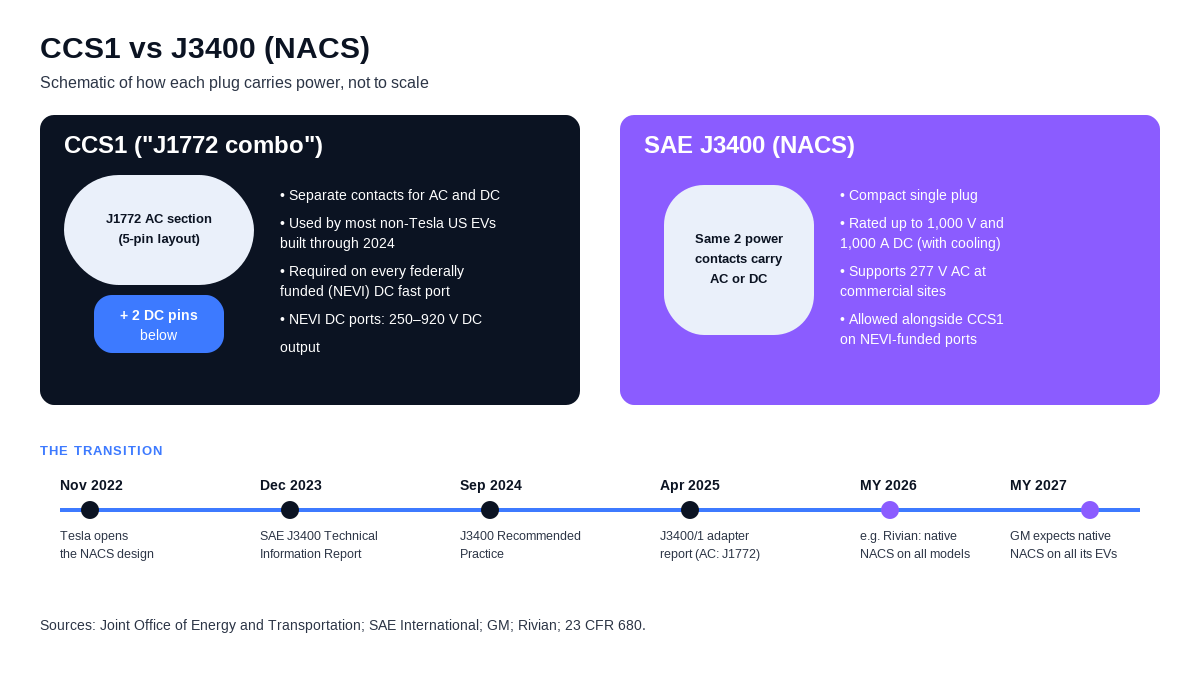
The charge port is where the car connects to an outside power supply to charge the traction battery [1]. In the US, the port is usually SAE J1772 (CCS, the "J1772 combo," adds two pins for DC fast charging) or SAE J3400, the connector SAE is standardizing based on Tesla's design. Some Japanese models use CHAdeMO for DC fast charging [8]. Our explainer on EV charging levels covers the plug types.
2. Onboard charger
Grid power is AC, but batteries store DC. The onboard charger takes incoming AC from the charge port and converts it to DC for the battery. It also talks to the charging equipment and monitors battery voltage, current, temperature and state of charge during charging [1].
At a DC fast charger, the AC-to-DC conversion happens inside each charging unit, which delivers DC power to the vehicle [10].
3. Traction battery pack
The traction battery stores the electricity that drives the motor [1]. Most of today's EVs use lithium-ion batteries. AFDC notes their exact chemistry often differs from batteries in phones and laptops [5]. Lithium-ion is used for its high energy per unit of mass and volume, high power-to-weight ratio, high energy efficiency and long life [5]. For how the cells work and how chemistries compare, see our guides to EV battery technology and LFP vs NMC batteries.
4. Power electronics controller (the inverter)
The power electronics controller manages the flow of electrical energy from the battery, controlling the motor's speed and the torque it produces [1]. Pressing the accelerator is effectively a request to this controller for more torque. You'll often see it called the inverter: the battery supplies DC, and DOE notes that an electric drive system needs an inverter to convert the battery's DC energy to AC power to drive the motor [9].
5. Electric traction motor
The motor uses power from the battery to drive the wheels. Many vehicles use motor-generators that both drive the car and recover energy [1]. DOE describes three main types [4]:
Motor type | Strengths | Trade-offs |
|---|---|---|
Interior permanent magnet (IPM) | High power density; high performance across most of the operating range | Needs rare earth elements (neodymium, dysprosium, terbium); costly rotor fabrication [4] |
Induction | High starting torque; high reliability; mature technology | Lower power density and overall performance than IPM [4] |
Switched reluctance | Low cost; easy to make; minimal critical materials; tolerates heat and speed | More noise and vibration, a big hurdle for passenger cars [4] |
DOE notes that despite rare earth cost and supply risks, automakers continue to favor IPM motors for plug-in and hybrid vehicles. Cutting rare earth use is a key research priority [4].
6. Transmission
The electric transmission transfers mechanical power from the motor to the wheels [1]. It's generally much simpler than a gasoline car's multi-speed gearbox, but designs vary by model.
7. Supporting systems
- DC/DC converter. Converts the battery's high-voltage DC to the lower voltage that runs accessories and recharges the auxiliary battery [1].
- Auxiliary battery. Powers vehicle accessories [1].
- Thermal system. Keeps the motor, power electronics and other components in their proper temperature range [1].
EV vs gasoline car: what's different under the skin
Function | Gasoline car | Battery electric car |
|---|---|---|
Energy storage | Fuel tank, pump, fuel lines | Traction battery pack [1] |
Making motion | Internal combustion engine | Electric traction motor [1] |
Controlling power | Throttle, engine management | Power electronics controller [1] |
Gears | Multi-speed transmission | Electric transmission [1] |
Slowing down | Friction brakes turn motion into heat | Regenerative braking plus friction brakes [3] |
Exhaust | Tailpipe emissions | None from the vehicle [1] |
Refueling | Gas station | Charge port and charging equipment [1] |
Regenerative braking: getting energy back
In a conventional car, braking turns the car's motion into wasted heat at the brake pads [3]. An EV uses regenerative braking: the wheels turn the motor, which generates electricity and helps slow the car [7]. That energy goes back into the battery for later use [3].
Regenerative braking helps most in stop-and-go traffic [3]. It's one reason all-electric vehicles are more efficient in city driving than on the highway [3][6].
Where the energy goes
Fueleconomy.gov breaks down an EV's energy use [3]:
- Efficiency to the wheels: 60% to 66% in city driving and 71% to 73% on the highway. If regenerated energy is counted when it's reused, efficiency can exceed 94% in the city and 77% on the highway [3].
- Charging losses. Energy is lost converting grid AC to DC and overcoming the battery's resistance to charging, which increases as the battery fills [3]. Battery charging efficiency is often 84% to 93% [2].
- Drivetrain losses. The motor, inverter and gear reduction lose some energy. ORNL's estimates assume 76.4% to 80.2% motor efficiency including inverter and gear losses, adjusted for parasitic losses [2].
- Accessories. Power steering and the powertrain cooling and control systems use energy [3].
Overall, fueleconomy.gov says EVs convert over 77% of the electrical energy from the grid to power at the wheels. Conventional gasoline cars convert only about 12% to 30% of the energy in gasoline [2].
Why cold weather cuts range
The breakdown above excludes cabin heating and cooling, which can be significant in extreme temperatures [3]. In very cold conditions, auxiliary electrical losses can account for more than 40% of energy use in city driving and more than 25% on the highway [3]. There's no engine waste heat to warm the cabin, so heating comes from the battery. AFDC notes that extreme outside temperatures tend to reduce range for this reason [6]. Fueleconomy.gov notes that preheating the cabin while plugged into the charger can extend range [11].
How EVs compare in practice
Fueleconomy.gov lists the main advantages: high energy efficiency, no tailpipe pollutants, quiet and smooth operation with strong acceleration, less maintenance than engines, and electricity as a domestic energy source [2]. The main drawbacks it lists are driving range and recharge time. Most EVs can travel more than 100 miles on a charge, and some exceed 200 or 400 miles depending on the model. Full recharges can take 3 to 12 hours, while a fast charge to 80% can take about 30 minutes [2].
On battery life, fueleconomy.gov cites a DOE study suggesting EV batteries may last 12 to 15 years in moderate climates and 8 to 12 years in severe ones [2]. When batteries reach the end of their vehicle life, AFDC notes they may still hold at least 70% of their original capacity if not failed or damaged, which makes them candidates for second-use energy storage [5].
If you're comparing powertrains, see EV vs hybrid vs plug-in hybrid. For what's selling in the US this year, see our ranking of the best-selling EVs in the USA in 2026.
Frequently asked questions
Do electric cars have a transmission?
Yes. AFDC lists an electric transmission among an EV's key components; it transfers mechanical power from the motor to the wheels [1]. It's generally simpler than a gasoline car's gearbox, though designs vary by model.
What does the inverter do in an EV?
The power electronics controller, often called the inverter, manages the energy flowing from the battery to the motor and controls the motor's speed and torque [1]. The inverter converts the battery's DC energy to the AC power that drives the motor [9].
Why are EVs more efficient than gasoline cars?
Electric drive systems lose only about 15% to 20% of their energy, compared with 64% to 75% for a gasoline engine. EVs also recover braking energy and waste no energy idling [3].
Does regenerative braking work on the highway?
Much less. Regenerative braking recovers energy when the car slows [7], so it pays off most in stop-and-go traffic. With little braking on the highway, it offers little advantage there over a conventional vehicle [3].
What is the 12-volt battery in an EV for?
The auxiliary battery powers vehicle accessories. The DC/DC converter keeps it charged from the main traction battery [1].
Sources
- U.S. Department of Energy, Alternative Fuels Data Center. "How Do All-Electric Cars Work?" https://afdc.energy.gov/vehicles/how-do-all-electric-cars-work
- fueleconomy.gov (DOE/EPA). "All-Electric Vehicles." https://www.fueleconomy.gov/feg/evtech.shtml
- fueleconomy.gov (DOE/EPA). "Where the Energy Goes: Electric Cars." https://www.fueleconomy.gov/feg/atv-ev.shtml
- U.S. Department of Energy, Transportation Technologies Office. "Research and Development for Advanced Motors and Electric Drives." https://www.energy.gov/node/804221
- U.S. Department of Energy, Alternative Fuels Data Center. "Batteries for Electric Vehicles." https://afdc.energy.gov/vehicles/electric-batteries
- U.S. Department of Energy, Alternative Fuels Data Center. "All-Electric Vehicles." https://afdc.energy.gov/vehicles/electric-basics-ev
- fueleconomy.gov (DOE/EPA). "How Hybrids Work." https://www.fueleconomy.gov/feg/hybridtech.shtml
- U.S. Department of Energy, Alternative Fuels Data Center. "Developing Infrastructure to Charge Electric Vehicles." https://afdc.energy.gov/fuels/electricity-stations
- U.S. Department of Energy, Vehicle Technologies Office. "Power Electronics Research and Development." https://www.energy.gov/eere/vehicles/power-electronics-research-and-development
- Francfort, J., et al. "Considerations for Corridor and Community DC Fast Charging Complex System Design." Idaho National Laboratory, INL/EXT-17-40829, May 2017. https://www.osti.gov/servlets/purl/1459664
- fueleconomy.gov (DOE/EPA). "Fuel Economy in Cold Weather." https://www.fueleconomy.gov/feg/coldweather.shtml