Level 2 vs DC Fast Charging: Which Should You Use, and When?
Level 2 vs DC fast charging compared on time, cost, battery wear and installation, with a scenario guide for home, apartment, road trip and site hosts.
For most EV drivers, Level 2 should do the everyday charging and DC fast charging should handle road trips and emergencies. Level 2 adds about 25 miles of range per hour, which is plenty while you sleep or work. DC fast charging adds roughly 100 to 200+ miles in 30 minutes, when you need distance quickly [1]. Home Level 2 runs at your residential electricity rate, while DC fast stations cost more to run partly because they're more likely to trigger utility demand charges [2][3]. And the battery research suggests heat, not the charger type alone, is what matters for battery wear [6].
If you want the mechanics first (voltages, where AC becomes DC, connector types), start with our explainer on EV charging levels. This guide is about the decision.
The short comparison
Level 2 | DC fast charging | |
|---|---|---|
Range added (AFDC estimate) | ~25 miles per hour [1] | ~100–200+ miles per 30 minutes [1] |
Power | 2.9–19.2 kW; most home units 7.2 kW [1] | Up to 500 kW available; the car and battery state of charge set the actual rate [1] |
Where the conversion happens | In the car's onboard charger [8] | Inside the station [9] |
Typical places | Home, work, destinations [1] | Highway corridors, charging hubs [1] |
Best for | Daily driving, long parking stops | Road trips, quick top-ups, high-mileage drivers |
Running cost (site owner) | Lower; less likely to trigger demand charges [3] | Higher; more likely to trigger demand charges [3] |
Time: do the math for your own driving
Start with how many miles you actually need to replace, not the battery's full size.
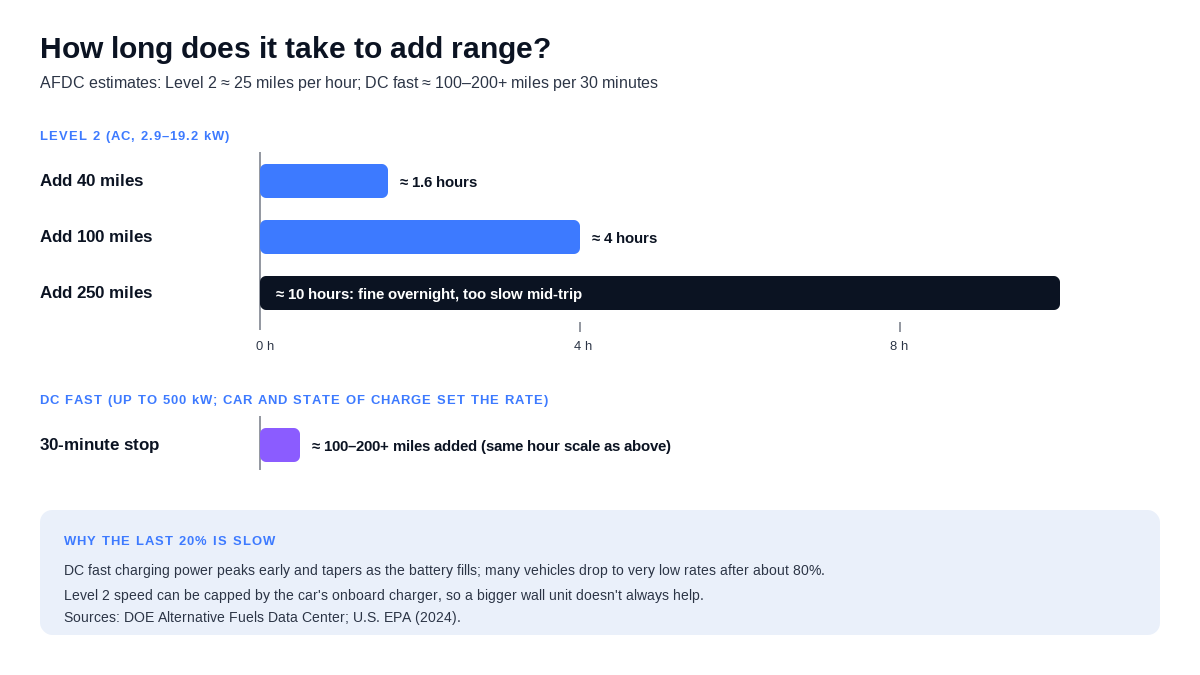
- A 40-mile daily commute. At about 25 miles per hour, Level 2 replaces that in roughly 1.6 hours [1]. Even Level 1 covers it overnight: AFDC estimates 8 hours at 120 V adds about 40 miles for a mid-size EV [1].
- 100 miles after a long day. About 4 hours on Level 2, so still easy overnight [1].
- A 250-mile highway day. Level 2 would need about 10 hours. A DC fast stop of around 30 minutes adds roughly 100 to 200+ miles [1].
The pattern is simple. If the car is parked for hours anyway, Level 2's speed doesn't cost you anything. DC fast charging only earns its premium when your time is the constraint.
Why "fast" isn't fast all the way to 100%
DC fast charging power depends on the battery's state of charge [1]. EPA's review of charging data shows front-loaded charging curves: power peaks early and tapers as the battery fills, and many vehicles drop to very low rates after about 80% [5]. Fueleconomy.gov notes that a fast charge to 80% can take about 30 minutes [7]. In practice:
- Arrive at a fast charger with a low battery, and leave when the rate drops off, often around 80%.
- Don't judge a car by its peak kW alone. EPA's presentation makes the point that peak charging is only part of the story, and manufacturers advertise charging capability in different ways [5].
- The car is often the bottleneck. AFDC notes many EVs on the road today can't charge at rates above 200 kW, even though units up to 500 kW are available [1]. For a snapshot of how many fast ports exist, see our report on US DC fast charging ports in March 2026.
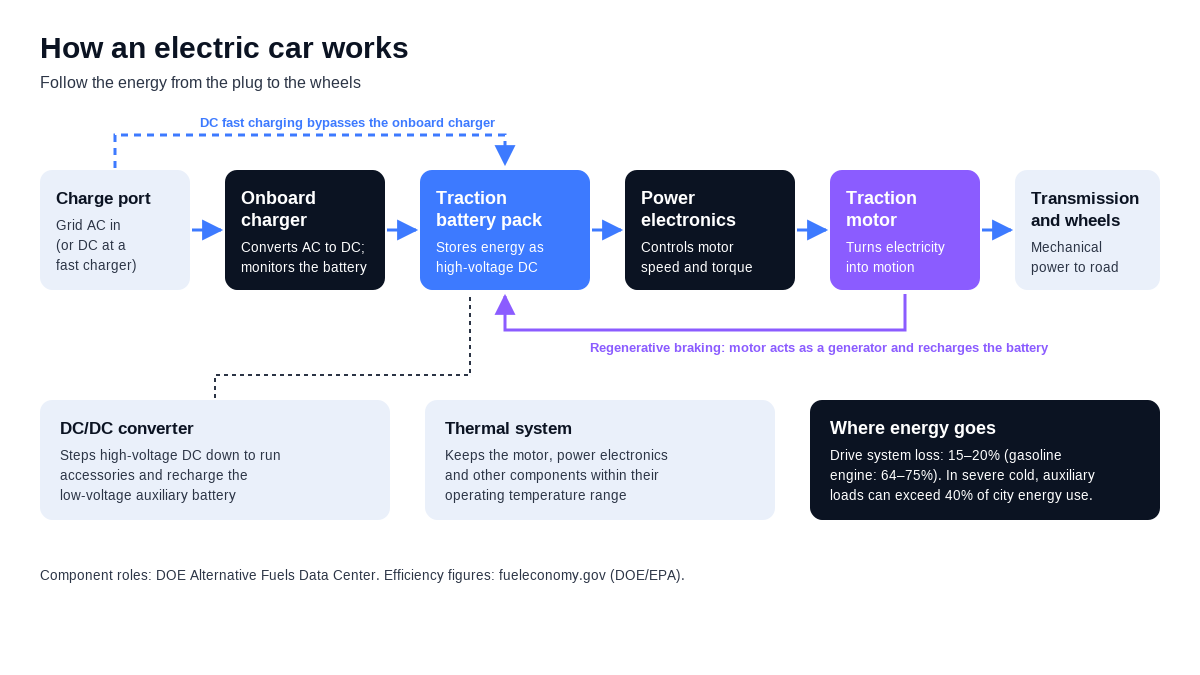
Level 2 has its own ceiling: the car's onboard charger, which converts the incoming AC to DC [8]. AFDC lists the vehicle's internal charger capacity among the factors that set charging time, so a 19.2 kW wall unit won't charge faster than the onboard charger accepts [1][8].
Cost: why home Level 2 usually wins
At home. AFDC's worked example: at 10.7 cents per kWh, a vehicle using 27 kWh per 100 miles costs about 3 cents per mile. A fully depleted 54 kWh battery costs about $6 to fill [2]. Use your own utility rate, because residential prices vary widely. Some utilities offer time-of-use rates that make overnight charging cheaper [2].
In public. Prices vary by network and site. Common pricing structures include per kWh, per session, by length of time or subscription, and member versus non-member rates [3]. More than 20% of public charging is free to use, according to AFDC [3].
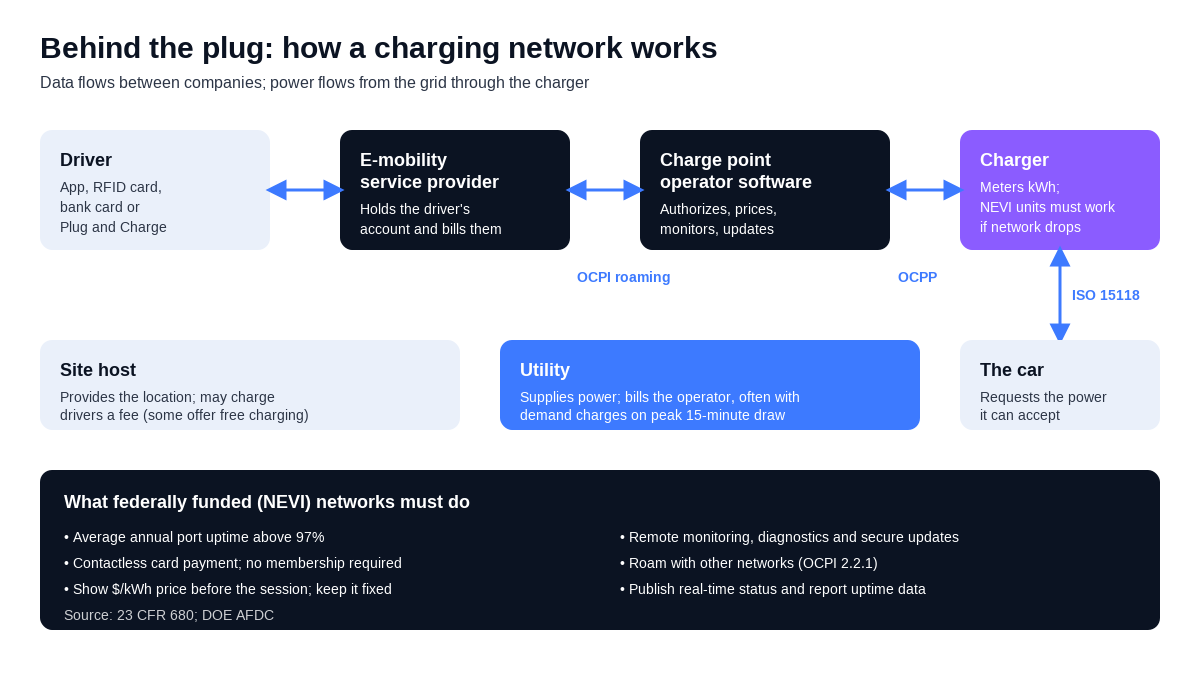
Why DC fast tends to cost more per kWh. Site owners often pay utility charges based on their highest 15-minute power draw in a billing period, known as demand charges. AFDC notes DC fast charging equipment is more likely to trigger demand charges than Level 1 and Level 2 [3]. Big power spikes cost money, and that shows up in the price.
What federal rules require of funded stations. At stations funded under the National Electric Vehicle Infrastructure (NEVI) program, the price must be shown before charging starts. It must be based on dollars per kWh, can't change once a session begins, and any extra fees must be clearly displayed [4]. As of November 2026, eCFR still shows these 2023 minimum standards in force.
For the full ownership picture (electricity, insurance, maintenance, depreciation), see our guide to how much it costs to own an EV.
Battery wear: what the research actually says
"Fast charging ruins your battery" is a common claim. The evidence is more nuanced.
Idaho National Laboratory (INL) ran a study on 2012 Nissan Leaf battery packs. One was charged exclusively with 50 kW DC fast charging, the other at 3.3 kW AC Level 2 [6]. At the cell level, fast charging had only a minor impact on performance. The full DC-charged pack, though, faded significantly faster than the cells suggested it would [6]. INL attributed much of that difference to heat. These packs had passive thermal management, with no active cooling, so cells packed between other modules ran hotter and aged unevenly [6]. INL also found that delayed fast charging, finishing shortly before driving, had less impact on degradation than conventional Level 2 charging [6].
What to take from it:
- Temperature is the key variable. Fast charging puts more heat into the battery, and how well the car removes that heat matters a lot [6].
- Results from older, passively cooled packs don't transfer directly to modern cars with active thermal management. The study itself warns that pack-level aging can't be extrapolated from cell tests [6].
- The car manages the rate. Charging power varies by vehicle and state of charge [1]. Automakers set those limits to protect the battery.
The practical approach: use Level 2 for routine charging, use DC fast charging when you need it, and follow your owner's manual. Chemistry matters too. Our guide to LFP vs NMC batteries explains how the two main chemistries handle charging and temperature differently.
Installing: what each one takes
Level 2 at home. Most homes have 240 V service. AFDC notes that a typical 30-amp residential unit (7.2 kW) needs a dedicated 40-amp circuit under National Electrical Code Article 625 [1]. EV charging counts as a continuous load under the NEC, and permits may be required [2]. An electrician can tell you whether your panel has capacity and can add circuits if needed [2]. AFDC recommends safety-certified equipment, such as ENERGY STAR certified units tested by a nationally recognized testing laboratory [2].
DC fast charging. This is commercial infrastructure, not a home option. Stations typically take three-phase AC input [1]. Federally funded corridor stations must have at least four ports, each able to deliver up to 150 kW at the same time, with output between 250 V and 920 V DC [4]. Federally funded Level 2 ports must deliver at least 6 kW each [4].
Which should you use? A scenario guide
Your situation | Primary | Backup | Why |
|---|---|---|---|
House with a garage or driveway | Home Level 2 | DC fast on trips | Cheapest energy; car is full every morning [1][2] |
Short commute (under ~40 miles/day) | Level 1 or Level 2 | — | Level 1 can cover it overnight [1] |
Apartment with no home charging | Workplace or destination Level 2 | Regular DC fast sessions | Fit charging into long parking stops; budget for public prices [3] |
Frequent long highway trips | Home Level 2 | Planned DC fast stops to ~80% | Fast stops are quickest in the lower part of the charge range [5] |
Rideshare or high-mileage driving | Level 2 overnight | DC fast midday | Time is money; fast charging fills gaps |
Business choosing what to install | Level 2 where people park for hours; DC fast where they stop briefly | — | Match charger speed to dwell time and demand-charge exposure [3] |
Frequently asked questions
Is it bad to use DC fast charging every day?
There's no simple yes or no. INL's research found that heat drives faster degradation, especially in packs without active cooling, while cell-level effects of fast charging were minor [6]. Modern cars manage charging power to protect the battery [1]. If you rely on fast charging daily, check your owner's manual and warranty terms.
Why does my DC fast charging session slow down?
Charging power depends on the battery's state of charge, and most cars taper sharply as they approach full. EPA notes many vehicles drop to very low rates after about 80% [1][5]. Battery temperature and the car's maximum charging rate also limit speed.
Do I need a Level 2 charger at home?
Not necessarily. If you drive under about 40 miles a day and park overnight, a standard 120 V outlet may be enough [1]. Level 2 is worth it for longer commutes, larger batteries or irregular schedules [2].
Is Level 2 charging cheaper than DC fast charging?
Usually, especially at home. AFDC's example works out to about 3 cents per mile at 10.7 cents per kWh [2]. DC fast stations are costlier to run partly because they're more likely to trigger utility demand charges, which tends to show up in prices [3].
Can I install a DC fast charger at home?
In practice, no. DC fast chargers typically need three-phase power, and federally funded corridor stations are built for 150 kW per port [1][4]. Home charging is Level 1 or Level 2.
Sources
- U.S. Department of Energy, Alternative Fuels Data Center. "Developing Infrastructure to Charge Electric Vehicles." https://afdc.energy.gov/fuels/electricity-stations
- U.S. Department of Energy, Alternative Fuels Data Center. "Charging Electric Vehicles at Home." https://afdc.energy.gov/fuels/electricity-charging-home
- U.S. Department of Energy, Alternative Fuels Data Center. "Operation and Maintenance for Electric Vehicle Charging Infrastructure." https://afdc.energy.gov/fuels/electricity-infrastructure-maintenance-and-operation
- Federal Highway Administration. 23 CFR Part 680, "National Electric Vehicle Infrastructure Standards and Requirements" (88 FR 12752, Feb. 28, 2023), via eCFR. https://www.ecfr.gov/current/title-23/chapter-I/subchapter-G/part-680
- Sobel, A. "DC Fast Charging Information for Consumers." U.S. EPA Office of Transportation and Air Quality, May 30, 2024. https://www.epa.gov/system/files/documents/2024-06/mstrs-spr-mtg-dc-fast-chrg-consumer-info-2024-05-30.pdf
- Tanim, T. R., Shirk, M. G., Bewley, R. L., Dufek, E. J., Liaw, B. Y. "Fast charge implications: Pack and cell analysis and comparison." Idaho National Laboratory, INL/JOU-17-43278; Journal of Power Sources 381 (2018) 56–65. https://inldigitallibrary.inl.gov/sites/sti/sti/Sort_3282.pdf
- fueleconomy.gov (DOE/EPA). "All-Electric Vehicles." https://www.fueleconomy.gov/feg/evtech.shtml
- U.S. Department of Energy, Alternative Fuels Data Center. "How Do All-Electric Cars Work?" https://afdc.energy.gov/vehicles/how-do-all-electric-cars-work
- Francfort, J., et al. "Considerations for Corridor and Community DC Fast Charging Complex System Design." Idaho National Laboratory, INL/EXT-17-40829, May 2017. https://www.osti.gov/servlets/purl/1459664