How EV Charging Networks Work: Operators, Software, Money and Uptime
Who runs public EV chargers, what happens when you plug in, how networks make money, and why uptime is hard, with US network data as of late 2026.
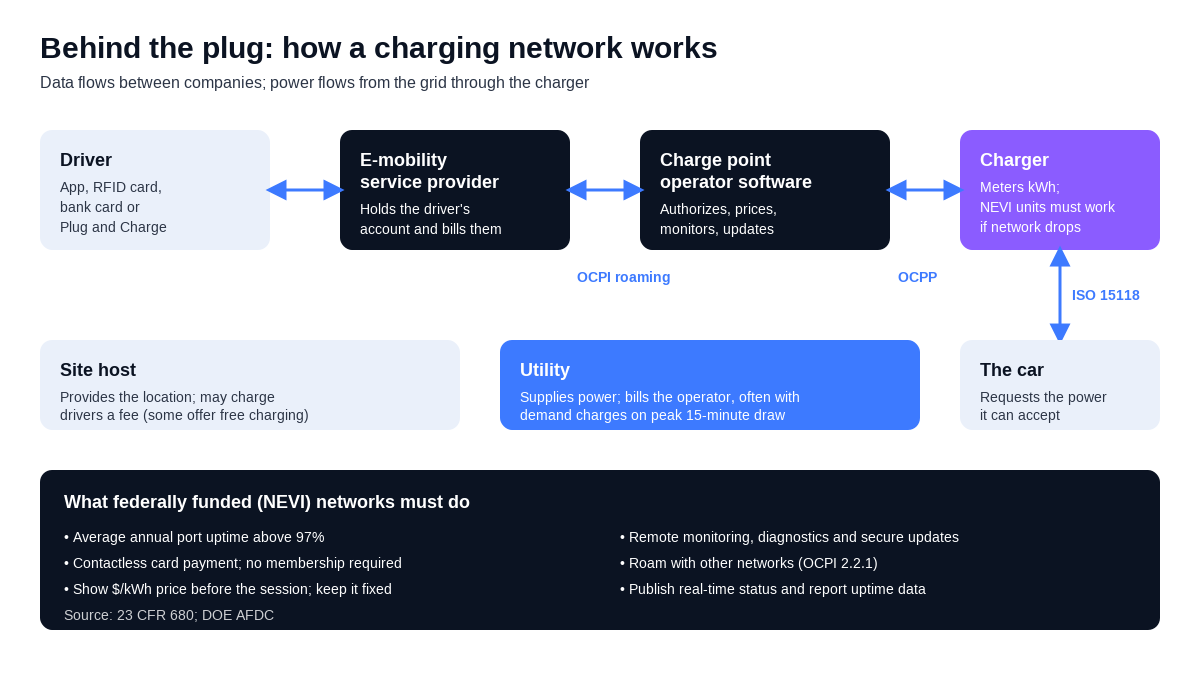
An EV charging network is a group of internet-connected chargers run by one operator through central software. That software authorizes drivers, controls and monitors each charger, sets prices, collects payment and reports data [2]. Roaming agreements let one app or account work across several networks [4]. The economics depend on equipment and installation costs, utility bills including demand charges, and how often the chargers are actually in use. Keeping chargers working, measured as uptime, is a core operational challenge: out-of-warranty repairs can be costly, and federally funded stations must meet a minimum uptime [1][2].
For the plugs and charging speeds themselves, see our explainers on EV charging levels and Level 2 vs DC fast charging.
Who's who in a charging network
Several different businesses can sit behind one charger:
Role | What they do |
|---|---|
Charge point operator (CPO) | Owns or runs the chargers and manages the stations. OCPI describes CPOs as the companies that manage charge stations [4]. Under federal rules, the "charging station operator" owns the chargers and supporting equipment [2]. |
E-mobility service provider (eMSP) | Has the driver as a customer, through an app, card or account, and uses OCPI roaming to connect them with other operators' chargers [4]. |
Site host | Provides the location (a store, parking garage or workplace) and may charge drivers a fee to recover costs or earn revenue [1]. |
Network software | The central management system that controls chargers remotely using OCPP [2][3]. |
Hardware maker | Builds the chargers. Some companies do several jobs: Tesla and ChargePoint both make hardware and operate networks [5]. |
Utility | Supplies electricity and bills the operator, often including demand charges [1]. |
One company can fill several roles. Tesla builds its own hardware and runs its own network. The IEA counted over 37,000 Tesla charging points in the US. ChargePoint both manufactures chargers and operates one of the largest US networks, with about 25,000 stations [5].
What happens when you plug in
A typical public DC fast charging session goes through these steps:
- Find a charger. Apps and maps pull location, real-time status and price data from networks. Federally funded stations must share this data, including real-time price in OCPI terms [2].
- Identify yourself. Use an app, an RFID card, a contactless bank card, or the car itself through Plug and Charge. NEVI-funded stations must accept contactless debit and credit cards and can't require membership [2].
- Authorize. The charger asks the operator's back end whether to start. That conversation runs over OCPP [2][3]. If you're using another company's app, the request is routed between networks over OCPI [4].
- Negotiate power. Car and charger agree on power over ISO 15118 or a similar protocol, then delivery follows the car's requests [2].
- Meter and bill. The charger measures energy delivered. Funded stations must show the $/kWh price before the session starts and keep it fixed for the whole session [2].
- Report. The network logs the session, any error codes and port status for the operator and, for funded stations, for regulators [2].
One resilience rule matters a lot here. NEVI-funded chargers must keep working, starting and finishing sessions at the minimum power, even if the connection to the network temporarily drops [2]. A charger that bricks itself when its cellular link fails strands drivers.
Networked vs non-networked chargers
Not every charger is networked. Most charging networks give site hosts utilization data through an online portal, though hosts of non-networked chargers can still collect fees through RFID, mobile apps or in-person payment [1]. AFDC describes two models of networked access [1]:
- Member-only access requires a network membership to use and pay for charging.
- Open access lets non-members pay by calling a customer service center or with a credit card on site, though these options limit the functions available to the driver.
How the money works
Costs
Equipment and installation. In the IEA's estimates for the US, in 2025 dollars, a 150–350 kW DC fast charger costs about $77,000 for equipment plus about $51,300 to install. A 50–150 kW unit costs about $41,100 for each. The IEA's installation figures exclude buying or renting land [5].
Electricity, including demand charges. Utility bills for commercial sites often include demand charges based on the highest 15-minute average power draw in a billing period. DC fast chargers are more likely to trigger them than Level 1 and Level 2 [1]. A few high-power sessions in a month can set a large part of the bill.
Networking and maintenance. Operators pay for software, connectivity and repairs. AFDC notes that routine maintenance can be minimal, but repairing chargers out of warranty can be costly. It recommends maintenance contracts that set response time, repair time and an overall uptime requirement [1].
Revenue
Pricing structures. Common models are per kWh, per session, per minute and subscription. Member and non-member rates, user-specific pricing and pricing by charging speed are also common [1]. Session- and time-based pricing is used where non-utilities aren't allowed to sell electricity [1]. More than 20% of public charging is free to use, according to AFDC [1].
Utilization decides profitability. A charger only earns money while a car is plugged in. US-wide utilization data isn't published in a standard way. The IEA's analysis of German data offers a reference point: time-based utilization rose from 1.5% in 2018 to almost 9% in 2022 and has held around 8% since. The busiest 5% of charging points are consistently above 25% [5]. Most chargers sit idle most of the time, which is why location and pricing strategy matter so much.
For what this means for drivers' wallets, see our EV charging cost vs gasoline breakdown.
Uptime: the hardest part
A broken charger is worse than no charger, because drivers plan around it. Uptime is now a regulated metric for federally funded stations:
- The 97% rule. Each NEVI-funded port must average more than 97% annual uptime, calculated monthly over the previous 12 months [2].
- Remote monitoring. Networks must perform, and chargers must support, remote monitoring, diagnostics, control and smart charge management. Chargers must accept secure remote software updates [2].
- Status reporting. Real-time port status and historical uptime must be measured, stored and reported [2].
- Five-year stewardship. Funded chargers must be maintained in compliance for at least five years [2].
- Industry effort. The ChargeX Consortium brings together Argonne National Laboratory, Idaho National Laboratory, the National Laboratory of the Rockies, industry and consumer advocates to measure and improve public charging reliability and usability [1].
Open protocols help here too. OCPP is an open protocol between chargers and charging management systems, which makes infrastructure less dependent on proprietary systems [3]. Federally funded chargers must be able to switch network providers without any hardware changes [2].
Roaming: one app for many networks
Drivers don't want a different app at every stop. Roaming solves this. An eMSP signs agreements with CPOs, directly or through a roaming hub, and exchanges locations, tariffs, sessions and billing over OCPI [4]. Federally funded networks must be able to roam with other networks so a driver can use a single method of identification across stations on multiple networks [2].
Automakers are building their own versions. GM's Energy Pass, inside its brand apps, combines registration and payment across Tesla Supercharger, IONNA, Electrify America and ChargePoint, with EVgo listed as coming soon (as of August 2026) [6].
The US network picture (as of late 2026)
- Size. The IEA reports the US ended 2025 with nearly 70,000 fast and ultra-fast public charging points (up 30% in a year) and over 160,000 slow points. 2025 was a record year for additions [5]. The IEA counts chargers up to 22 kW as slow, so its categories don't map one-to-one onto Level 1 and Level 2.
- Density. About 33 EVs per public charging point at the end of 2025, up from under 20 in 2020. That's offset by Americans' greater access to home charging [5].
- Federal program. NEVI obligations were paused from February 2025 to January 2026. About 550 NEVI-funded fast charging points were operating in 19 states as of April 2026 [5].
- Plug transition. CharIN reports Tesla's more than 34,000 US fast-charging ports are mostly open to non-Tesla EVs now. (Counts differ by source and definition: the IEA's figure above covers all Tesla charging points in the US.) Other networks are adding dual CCS/NACS dispensers [7]. See our explainer on Tesla NACS vs CCS.
Tips for drivers
- Check live status before you go, and have a backup station on long trips. Funded stations must publish real-time port status [2].
- Compare member and guest prices if you use one network often [1].
- Look for $/kWh pricing, which is easiest to compare. Funded stations must show it before you start [2].
- Use your automaker's app or a roaming app to cut down the number of accounts you need [4][6].
- Report broken chargers. Funded stations must provide ways to report outages and malfunctions [2].
Frequently asked questions
Who owns public EV chargers?
It varies. Chargers may be owned by a charging company, a site host such as a retailer, a utility or an automaker. Federal rules define the charging station operator as the entity that owns the chargers and supporting equipment, even if it delegates operations [2]. Some companies, such as Tesla and ChargePoint, both make the hardware and run the network [5].
Why do I need different apps for different chargers?
Each operator runs its own software and accounts. Roaming over OCPI lets one provider's app work on other networks [4]. Contactless card payment at many stations, required at NEVI-funded ones, also lets you skip the app [2].
Why are some chargers broken so often?
Chargers combine high-power electronics, cables, payment hardware and network connections, and any of them can fail. Maintenance responsibility can also be unclear between site host, network and installer, which AFDC flags as something to settle in contracts [1]. Federally funded stations must average over 97% uptime [2].
How do charging networks make money?
Mainly from charging fees: per kWh, per minute, per session or by subscription [1]. Some site hosts offer charging free; AFDC notes more than 20% of public charging costs nothing to use [1]. Profitability depends heavily on utilization and on utility demand charges [1][5].
What is roaming in EV charging?
Roaming lets you charge on a network you don't have an account with, using your own provider's app or card. Your provider and the operator settle the bill behind the scenes over a protocol such as OCPI [4].
Sources
- U.S. Department of Energy, Alternative Fuels Data Center. "Operation and Maintenance for Electric Vehicle Charging Infrastructure." https://afdc.energy.gov/fuels/electricity-infrastructure-maintenance-and-operation
- Federal Highway Administration. 23 CFR Part 680, "National Electric Vehicle Infrastructure Standards and Requirements" (88 FR 12752, Feb. 28, 2023), via eCFR. https://www.ecfr.gov/current/title-23/chapter-I/subchapter-G/part-680
- Open Charge Alliance. "Open Charge Point Protocol." https://openchargealliance.org/protocols/open-charge-point-protocol/
- EVRoaming Foundation. "OCPI: Open Charge Point Interface." https://evroaming.org/ocpi/
- International Energy Agency. "Global EV Outlook 2026." May 2026. https://www.cleanenergyministerial.org/content/uploads/2026/05/globalevoutlook2026.pdf
- General Motors. "Every GM electric vehicle with NACS charging." August 2026. https://news.gm.com/home.detail.html/Pages/topic/us/en/2026/aug/0813-electric-vehicle-nacs-charging.html
- CharIN. "The shift to NACS: What it means for the future of EV charging in North America." January 16, 2026. https://www.charin.global/news/the-shift-to-nacs-what-it-means-for-the-future-of-ev-charging-in-north-america/