Self-Driving Cars: How the Technology Works and What Holds It Back
How self-driving cars sense, predict and plan, what the crash data shows as of 2026, and the hard problems left: rare events, proof of safety and rules.
A self-driving car replaces the human driver with a stack of sensors, maps and software. The system works out where it is, what's around it and what those things will do next, then chooses a path and steers, brakes and accelerates to follow it [1]. Waymo runs a driverless robotaxi service for the public in several US cities, and the published crash data so far looks good [4]. The hard part that's left is proving the system is safe across rare events, new cities and bad weather, and fitting it into rules written for human drivers [4][5][7].
This guide covers how the technology works and where it struggles. For what "Level 2" or "Level 4" means, and how NHTSA's crash-reporting order works, see our guide to the SAE autonomous driving levels.
Self-driving vs driver assistance
Nearly all automation in cars people can buy is driver assistance. The Insurance Institute for Highway Safety (IIHS) notes that Level 3 systems are very rare and Level 5 vehicles don't yet exist [4]. It points out that Level 2 systems such as GM's Super Cruise and Ford's BlueCruise require a human driver to stay alert and ready to take over at all times [4]. Waymo's vehicles, by contrast, are classified as Level 4: the automation does all the driving with no human supervision under certain conditions [4].
That difference shapes the whole design. A Level 2 system can lean on the human as the backup. A driverless system has no one to hand control to, so it must detect its own failures and reach a safe state by itself. Everything below is about that harder case.
How a self-driving car works: five jobs
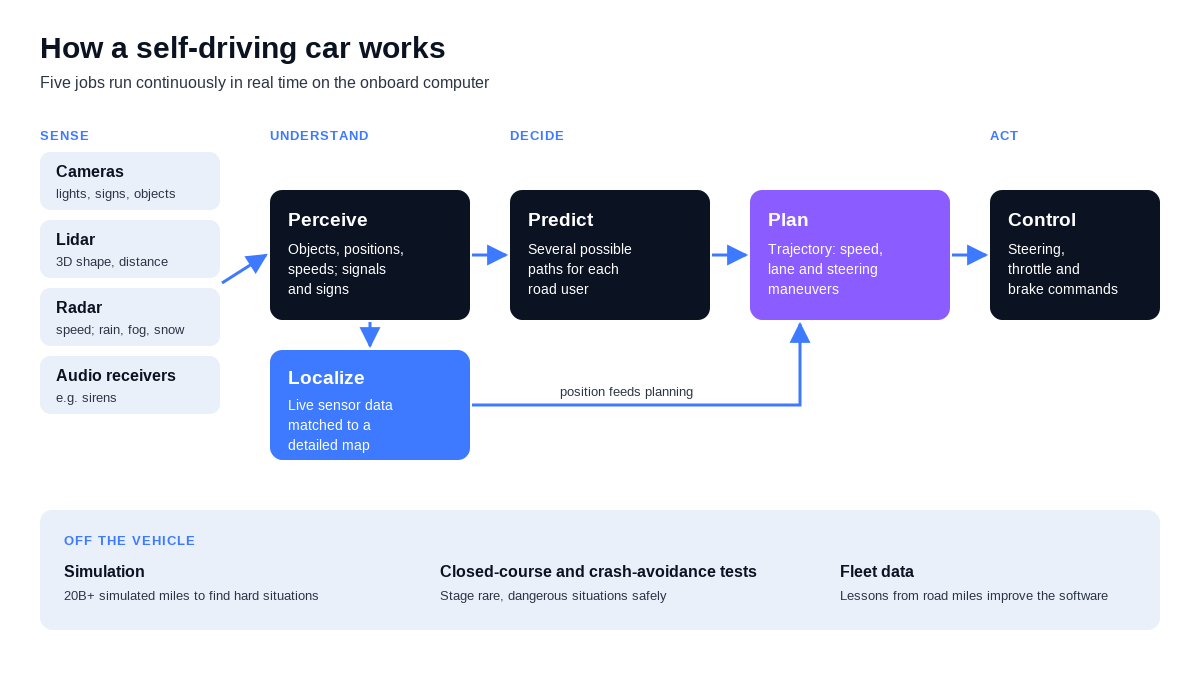
Developers organize the software differently, but every automated driving system has to do the same five jobs.
1. Sense the world
Waymo's driverless vehicles combine three types of sensor, which back each other up [1][2]:
Sensor | How it works | What Waymo uses it for |
|---|---|---|
Camera | Captures images; software reads them | Spots traffic lights, signs, construction zones and other objects, even hundreds of meters away; built for daylight and low light [1] |
Lidar | Sends laser pulses and times how long they take to bounce back [1] | A 3D view of the surroundings, whatever the time of day [1] |
Radar | Millimeter-wave radio measures distance and speed [1] | Distance and speed of objects; effective in rain, fog and snow [1] |
Waymo's 6th-generation hardware uses 13 cameras, 4 lidar, 6 radar and external audio receivers that listen for things like sirens. Waymo says the suite gives overlapping views all around the vehicle out to 500 meters [2]. The overlap is deliberate. Waymo describes the three sensing modalities as redundancy, so one can cover for another in unexpected weather or a sensor fault [2].
2. Know exactly where it is
Waymo maps an area in detail before it operates there, down to lane markers, curbs, crosswalks and stop signs. The car then matches live sensor data against that map to work out its exact position [1]. The trade-off is that every new city needs mapping work, and the map has to be kept current when roads change.
3. Perceive: what is around me?
Perception software turns raw sensor data into a list of objects with positions, sizes and speeds: pedestrians, cyclists, cars and construction. It also reads signals and signs, including temporary stop signs [1]. Waymo uses AI for this [1]; for background on the underlying machine-learning techniques, see our guide to how large language models work.
4. Predict: what will everyone do next?
A busy street can hold hundreds of objects, each with its own intentions. The prediction module estimates several possible paths for each one, using the knowledge that a cyclist moves differently from a car or a pedestrian [1]. Getting this wrong is dangerous even when perception works. In the fatal 2018 Uber test crash in Tempe, Arizona, the system detected the pedestrian 5.6 seconds before impact. But according to the NTSB, it never accurately classified her as a pedestrian or predicted her path [6].
5. Plan and act
The planner weighs the map, the objects and their predicted paths, then picks a trajectory: exact speed, lane and steering maneuvers [1]. The control layer turns that plan into steering, throttle and brake commands. All of this runs on an onboard computer. In Waymo's case that means server-grade CPUs and GPUs processing data from dozens of sensors in real time [1]. (For why AI workloads run on GPUs, see our explainer on AI chips vs CPUs vs GPUs vs TPUs.)
Outside the car: testing and simulation
Driving software is developed and validated off the road as much as on it. Waymo reports more than 20 billion miles in simulation and more than 40,000 unique scenarios on closed test tracks. It also runs crash-avoidance tests that recreate dangerous situations such as a car suddenly pulling out of a driveway [1]. Hardware is environmentally tested too: water jets, salt-mist chambers, vibration, heat and freezing [1].
What the safety data shows (as of late 2026)
Two sources give the clearest picture, and both cover Waymo. Waymo publishes its driverless mileage; other companies aren't required to report theirs [3][4].
Waymo's own hub. Through June 2026, Waymo reports 271.3 million rider-only miles, meaning miles with no human driver [3]. Compared with a modeled human crash rate for the same distance in the same cities, Waymo reports [3]:
- 95% fewer crashes with serious injury or worse (55 fewer);
- 82% fewer injury-causing crashes (841 fewer);
- 93% fewer pedestrian crashes with injuries (87 fewer).
Waymo counts these crashes regardless of who was at fault [3].
The independent IIHS study (July 2026). IIHS cleaned up crash reports filed with NHTSA from 2021 to 2024, kept only crashes a person would typically report to police, and compared Waymo's roughly 50 million driverless miles with about 222 billion human miles in the same places [4]. Waymo's crash involvement rate was 68% lower overall: 76% lower in Phoenix, 71% lower in Los Angeles, 35% lower in San Francisco and 4% higher in Austin, where the sample was small. Waymo also had 81% fewer injury crashes per mile [4].
How to read these numbers. They are encouraging, but limited:
- They describe one company, in a handful of cities, under its own operating conditions. They don't cover other developers or driving everywhere.
- Human benchmarks are estimates. IIHS notes that around half of all crashes and a third of injury crashes involving human drivers go unreported [4].
- Other companies must report crashes to NHTSA but are not required to report miles. That makes their crash rates impossible to calculate [4]. IIHS concluded that the present data system "isn't good enough to allow continuous monitoring of a large-scale expansion" [4].
The hard problems that remain
Proving safety with miles is not practical
Serious crashes are rare per mile driven, so showing statistically that a driverless car is safer takes enormous distances. RAND estimated that fully autonomous vehicles would need hundreds of millions, and sometimes hundreds of billions, of miles to demonstrate their safety in terms of fatalities and injuries. Its conclusion was that developers "cannot simply drive their way to safety" [5]. That is why the industry leans on simulation and structured tests [1], and why the draft UN regulation on automated driving included requirements for a safety case and for the testing used to qualify the system [7].
The long tail of rare situations
Ordinary driving is the easy part. The difficulty is the unusual situation: an unexpected object, a person behaving oddly, a construction layout that doesn't match the map. The Tempe crash shows how a perception and prediction miss can combine with a design gap. NTSB found that the system's design precluded emergency braking for collision mitigation and relied on the human operator instead [6].
Weather and new cities
Waymo says its 6th-generation system is designed to handle extreme heat, fog, rain and hail. It says winter road trips shaped its 6th-generation design, such as sensor cleaning for cold climates [2]. Each new region still means new mapping, new local driving behavior and new validation, which is one reason expansion happens city by city.
Cost and business viability
Redundant sensors and server-grade computers are expensive. Waymo's 6th-generation hardware was designed specifically to cut cost while keeping redundancy [2]. The business is unforgiving even for large players. In December 2024, GM said it would stop funding Cruise's robotaxi development, citing "the considerable time and resources that would be needed to scale the business" and a competitive robotaxi market. It shifted its focus to driver assistance and personal autonomous vehicles [8].
Rules written for human drivers
Many US federal motor vehicle safety standards (FMVSS) were written decades ago for human-driven vehicles with manual controls [7]. As of late 2026, NHTSA is working through this in several ways [7]:
- On March 16, 2026, it proposed changes to FMVSS Nos. 102, 103 and 104 for ADS-equipped vehicles without manual controls, followed by similar proposals for other standards.
- On March 10, 2026, it began a rulemaking toward performance requirements for automated driving systems themselves.
- It is streamlining exemptions so companies can deploy non-compliant designs while those rules are written.
Internationally, a UN Global Technical Regulation on automated driving systems was adopted on June 24, 2026, with the US voting in favor. NHTSA describes it as the first unified global framework for SAE Level 4 and 5 vehicles [7]. These are proposals and frameworks, not finished US rules. Expect the details to keep changing.
Oversight and public trust
NHTSA's crash-reporting order is the main national data source. From June through December 2025, it received reports of 517 alleged crashes involving automated driving systems and 787 involving Level 2 driver assistance. NHTSA says its follow-up through July 2026 contributed to seven formal investigations and seven recalls [7]. Those are counts of reports, not crash rates, and they don't establish fault.
How to judge a self-driving claim
- Ask who is responsible for driving. If the human must supervise, it's driver assistance, whatever the marketing name.
- Ask for miles, not anecdotes. A crash count means little without the miles driven and a comparable human baseline [4].
- Check the operating area. Results in one city, in fair weather, don't transfer automatically to another city or season.
- Look for independent analysis. Company dashboards are useful. Studies like IIHS's, which re-clean the data, are more convincing [4].
Outlook
The near-term picture, as of late 2026, is gradual expansion of geofenced robotaxi services, alongside steadily more capable driver assistance in personally owned cars. GM's strategy reset points to a path through driver assistance toward personal autonomy [8]. The pace will depend on three things: whether independent safety data stays strong as fleets grow, whether the cost of hardware keeps falling, and how quickly NHTSA turns its proposals into final standards [2][4][7]. Treat any specific date for "self-driving everywhere" as a prediction, not a plan.
Frequently asked questions
Are self-driving cars safer than human drivers?
For Waymo in the cities it operates, the data so far says yes: IIHS found a 68% lower police-reportable crash rate, and Waymo reports 95% fewer serious-injury crashes against its human benchmark [3][4]. That evidence covers one company and limited areas, so it doesn't prove that all self-driving systems are safer everywhere.
Why do some self-driving cars use lidar, radar and cameras together?
They do different jobs. Cameras read traffic lights and signs, lidar builds a 3D view day or night, and radar measures distance and speed and works in rain, fog and snow [1]. Combining them provides overlapping coverage and redundancy, which Waymo describes as essential for safety [2].
Can I buy a fully self-driving car today?
Not in the Level 4 sense. Consumer systems such as Super Cruise and BlueCruise are Level 2 and require you to stay alert and ready to take over at all times [4]. IIHS notes that Level 3 systems are very rare and Level 5 vehicles don't yet exist [4].
Why can't companies just drive more miles to prove safety?
Fatal and injury crashes are rare per mile driven. RAND calculated that demonstrating safety statistically could take hundreds of millions to hundreds of billions of miles, which would take existing fleets decades or longer [5]. Simulation and structured testing fill the gap [1].
Who regulates self-driving cars in the US?
NHTSA sets federal vehicle safety standards, grants exemptions and requires crash reports for automated driving systems and Level 2 systems [7]. Federal rules for vehicles without manual controls were still at the proposal stage as of late 2026 [7].
Sources
- Waymo. "Self-Driving Car Technology for a Reliable Ride - Waymo Driver." https://waymo.com/waymo-driver/
- Waymo. "Meet the 6th-generation Waymo Driver: Optimized for costs, designed to handle more weather, and coming to riders faster than before." August 2024. https://waymo.com/blog/2024/08/meet-the-6th-generation-waymo-driver
- Waymo. "Safety Impact" (data through June 2026). https://waymo.com/safety/impact/
- Insurance Institute for Highway Safety. "Waymo's driverless cars crash less often than people." July 23, 2026. https://iihs.org/news/detail/waymos-driverless-cars-crash-less-often-than-people
- Kalra, N. and Paddock, S. M. "Driving to Safety: How Many Miles of Driving Would It Take to Demonstrate Autonomous Vehicle Reliability?" RAND Corporation, RR-1478-RC, 2016. https://www.rand.org/pubs/research_reports/RR1478.html
- National Transportation Safety Board. "Collision Between Vehicle Controlled by Developmental Automated Driving System and Pedestrian, Tempe, Arizona, March 18, 2018" (HWY18MH010). https://www.ntsb.gov/investigations/Pages/HWY18MH010.aspx
- National Highway Traffic Safety Administration. "AV Framework Updates and Request for Comments on Interim Guidance," Docket NHTSA-2026-1552, Federal Register (scheduled for publication July 31, 2026). https://public-inspection.federalregister.gov/2026-15483.pdf
- General Motors. "GM to refocus autonomous driving development on personal vehicles." December 10, 2024. https://news.gm.com/home.detail.html/Pages/news/us/en/2024/dec/1210-gm.html