Electric Commercial Trucks: How They Work and Where They Fit
How battery-electric trucks work, from Class 4 vans to Class 8 tractors: battery sizes, depot and megawatt charging, weight rules and US policy as of 2026.
An electric commercial truck is a medium- or heavy-duty truck that runs on a large battery pack and electric motors instead of a diesel engine. Today they work best on predictable routes that return to a depot each night: delivery vans, box trucks, drayage between ports and warehouses, and regional hauls of a few hundred miles. Long-haul trucking is harder because it needs very large batteries and high-power charging along highways, which is still being built out. US policy support also shrank in 2025 and 2026 [5][6][7].
What counts as a commercial electric truck
Commercial trucks are grouped by gross vehicle weight rating (GVWR), the maximum loaded weight the manufacturer allows. In US shorthand:
- Medium duty (roughly Classes 3–6): step vans, cutaway box trucks, utility bodies and small refuse trucks.
- Heavy duty (Classes 7–8): larger straight trucks, refuse and vocational trucks, and the tractor units that pull semitrailers.
The IRS uses a simpler line for tax purposes: vehicles under 14,000 pounds GVWR versus those at or above it [5]. That's why "electric truck" can mean anything from a delivery van to an 82,000-pound tractor-trailer.
For the basics of how an electric drivetrain works, see our electric vehicles beginner's guide and the explainer on how electric vehicles work.
How the drivetrain differs at truck scale
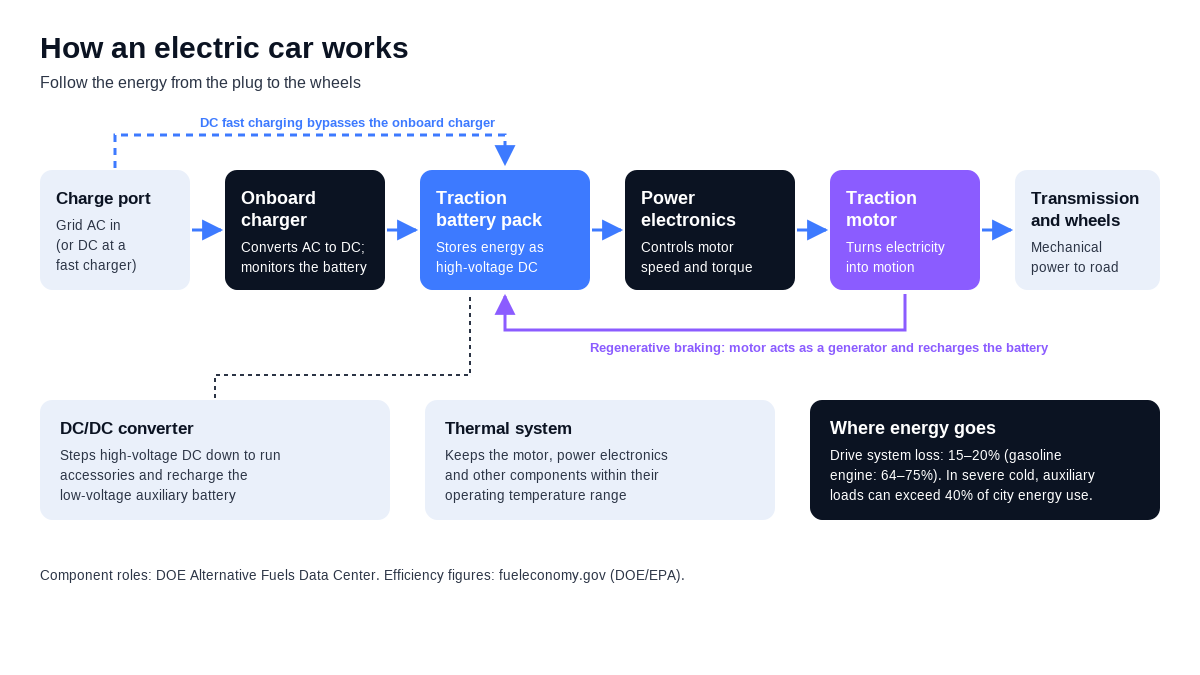
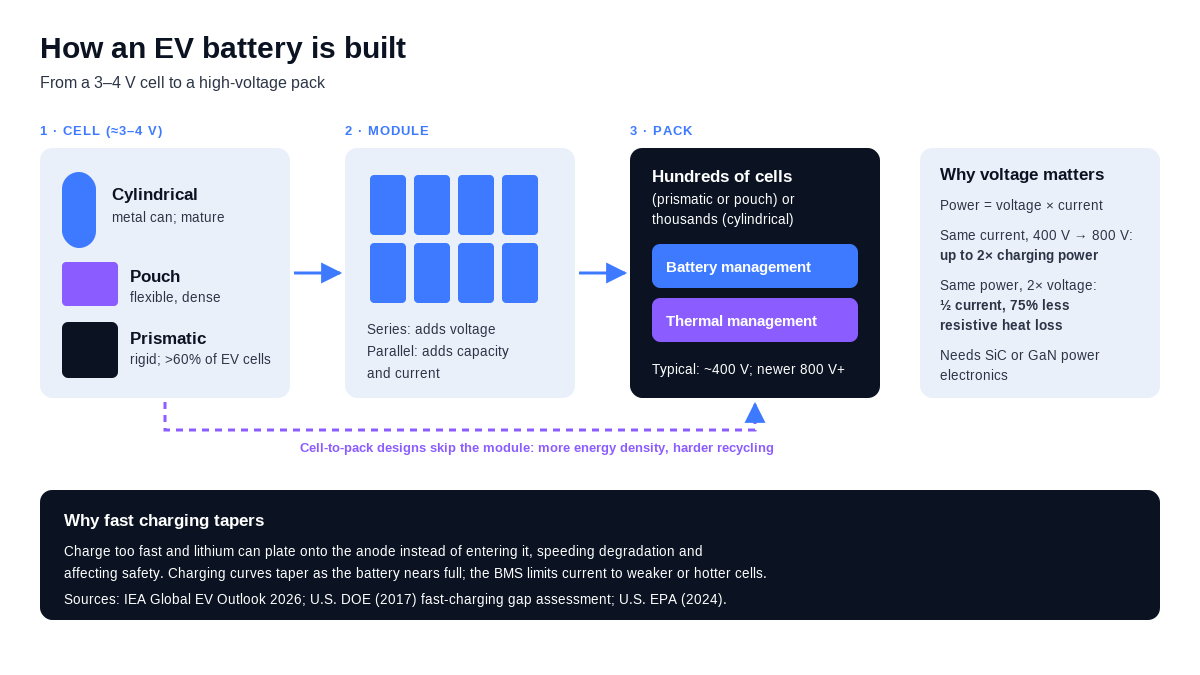
A battery-electric truck uses the same building blocks as an electric car: a battery pack, an inverter, one or more motors, and a battery management system. What changes is scale.
- Battery size. DOE's Alternative Fuels Data Center lists manufacturer specs for models on sale. The Peterbilt 567EV, a Class 8 truck, is offered with 250 to 625 kWh of battery and an electric-only range of 100 to 250 miles [1]. The Freightliner eCascadia (single drive) lists 291 to 438 kWh and 230 miles [1]. For comparison, most passenger EV packs are well under 150 kWh.
- Motors and axles. Many heavy trucks use e-axles, with the motors built into the drive axle. AFDC listings for the eCascadia show Detroit ePowertrain e-axles rated from 320 to 470 horsepower [1].
- Charging hardware. Peterbilt quotes a 350 kW maximum charging rate, reaching 80% in 80–120 minutes on its larger packs (manufacturer claim) [1].
Battery chemistry matters too. Many truck makers offer lithium iron phosphate (LFP) for durability and cost, while others use nickel-based cells for energy density. See our comparison of LFP vs NMC batteries.
Range, payload and the weight question
A big battery is heavy, and trucks are weight-limited. If the battery adds weight, the truck can carry less cargo before it hits the legal limit.
Federal law offers partial relief. Under 23 U.S.C. 127(s), as amended in 2019, a vehicle powered primarily by electric battery power may exceed the weight limit on the power unit by up to 2,000 pounds. The total is capped at 82,000 pounds gross vehicle weight on the Interstate System [4]. FHWA's guidance says the allowance applies to the axle and bridge-formula limits on the power unit, not just to gross weight [4].
In practice, this means:
- Weight-limited freight (dense loads like beverages, building materials, aggregate) feels the battery penalty most.
- Volume-limited freight (parcels, light consumer goods) often stays under the weight limit anyway, so the battery's mass costs little or no payload.
Range also depends on load, terrain, speed and temperature. Treat a manufacturer's range figure as a best case, and test on your own routes.
How electric trucks charge
Depot charging
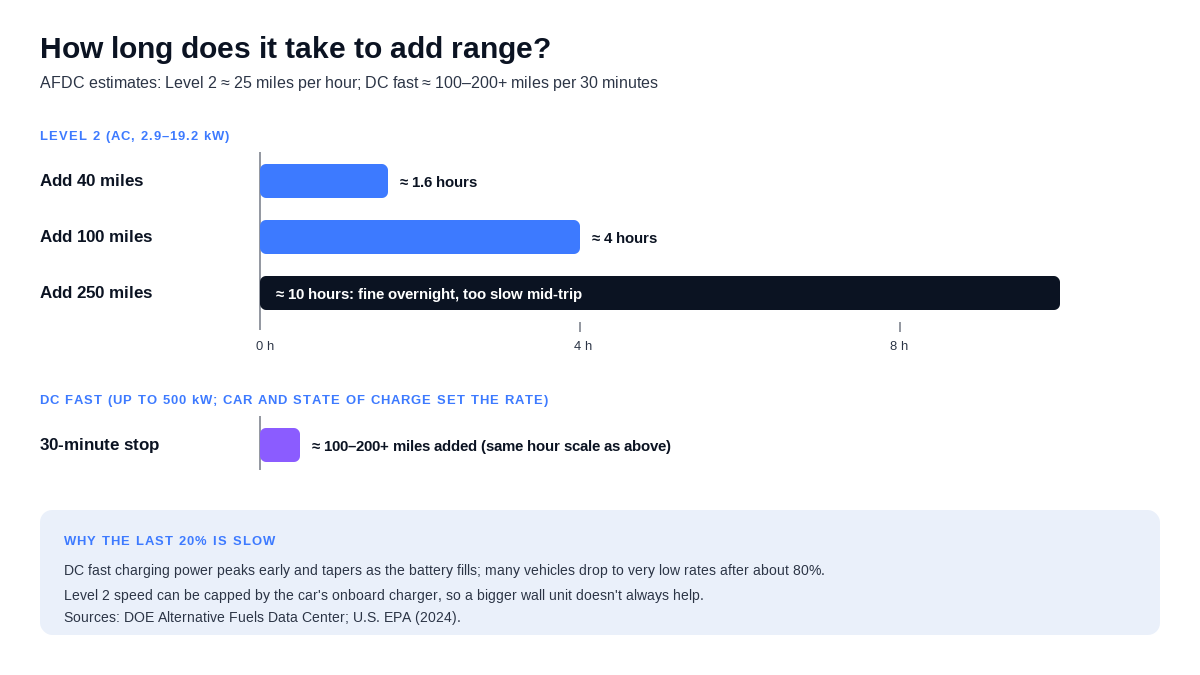
Most electric trucks today charge overnight or between shifts at the fleet's own yard. The trucks return to base, plug into Level 2 or DC chargers, and leave full. This is the simplest model because the fleet controls the site, the schedule and the electricity contract. Our explainer on EV charging levels covers the hardware basics, and Level 2 vs DC fast charging compares the two in more detail.
The hard part is often the utility connection, not the chargers. A depot with dozens of trucks charging at once may need a new transformer or service upgrade, which can take a long time. Plan for it early.
Megawatt charging
Heavy trucks with 500+ kWh packs need far more power to recharge during a driver's break. SAE published J3271, the Megawatt Charging System (MCS) document, as a Technical Information Report in March 2025 [3]. It covers couplers, communications and controls, cables, grid-interconnection use cases and interoperability testing [3]. MCS is meant for the large, high-power connections that passenger-car connectors weren't designed for. For context on US connector standards, see EV charging standards in the United States.
What this means for operations
Duty cycle | Typical charging approach | Fit for battery-electric today |
|---|---|---|
Last-mile delivery (vans, step vans) | Overnight depot | Strong: short, predictable routes |
Drayage (port to warehouse) | Depot plus midday top-up | Strong where depot power is available |
Refuse and vocational | Depot | Good: return-to-base, lots of stop-and-go |
Regional haul (up to a few hundred miles) | Depot plus public or partner DC charging | Workable on known routes |
Long-haul, irregular routes | Needs high-power highway charging (MCS) | Limited until corridor charging is built |
The cost picture
Buying an electric truck usually costs more up front than buying a diesel. The case rests on lower energy and maintenance costs over the truck's life. Whether the numbers work depends on:
- Electricity price and demand charges. Commercial tariffs often include charges based on peak power draw. Smart charging that spreads the load can make a big difference.
- Annual mileage. The more miles a truck drives, the more fuel savings it collects.
- Charging infrastructure cost. Chargers, electrical upgrades and installation can be a large share of the project.
- Incentives, which changed sharply (see below).
DOE published a National Renewable Energy Laboratory study in March 2022. It projected that by 2030 nearly half of medium- and heavy-duty trucks would be cheaper to buy, operate and maintain as zero-emission vehicles than as diesels [2]. The same DOE release noted that medium- and heavy-duty vehicles are less than 5% of vehicles on the road but produce over 20% of US transportation emissions [2]. That projection predates the 2025–2026 policy changes, so treat it as one scenario, not a forecast for today. For the light-duty version of this math, see how much it costs to own an EV.
What changed in US policy (as of November 2026)
Three changes reshaped the outlook for US fleets:
- The federal truck tax credit ended. The Qualified Commercial Clean Vehicle Credit (Internal Revenue Code 45W) was worth up to $40,000 per vehicle. It isn't available for vehicles acquired after September 30, 2025 [5].
- Federal truck greenhouse gas standards were repealed. On February 12, 2026, EPA finalized the rescission of the 2009 endangerment finding. It repealed all greenhouse gas standards for light-, medium- and heavy-duty highway vehicles and engines, which covers the truck greenhouse gas rules [6]. Criteria-pollutant rules (such as NOx limits) aren't affected [6].
- California's Advanced Clean Trucks waiver was nullified. Congress passed H.J. Res. 87 under the Congressional Review Act, and it was signed June 12, 2025 (Public Law 119-15). It disapproved EPA's waiver for California's Advanced Clean Trucks rule, stating the rule "shall have no force or effect" [7].
The light-duty market shows how fast incentives can shift demand. EIA reports that battery-electric cars fell to 6% of new light-duty sales in the third quarter of 2026, down from 10% a year earlier, after the federal consumer and commercial credits expired [8]. Trucks follow different economics, but the policy direction is the same.
How to decide whether an electric truck fits
Use this checklist before you commit:
- Map real duty cycles. Pull telematics data for daily miles, dwell time at the depot, payload and seasonal temperature swings.
- Check payload sensitivity. If your loads regularly hit the weight limit, calculate cargo lost to battery weight even with the 2,000-pound allowance [4].
- Talk to the utility first. Ask about service capacity, upgrade timelines and commercial EV tariffs before ordering trucks.
- Model total cost without federal credits. Since 45W ended for new acquisitions [5], run the numbers with state or utility incentives only, and treat any you find as upside.
- Pilot before scaling. Start with the routes that fit best (short, predictable, return-to-base) and expand once you have your own data.
Outlook
Battery-electric trucks are an established option for urban and regional work. Long-haul adoption depends on bigger, cheaper batteries, MCS-capable corridor charging and cost parity without subsidies. In the US, federal policy as of late 2026 no longer pushes fleets toward zero-emission trucks, so adoption will be driven mostly by operating economics, state programs and customer demand. For the bigger picture, see the future of electric mobility in America.
Frequently asked questions
How far can an electric semi truck go on a charge?
It depends on the model, battery size and load. AFDC manufacturer listings show Class 8 models with electric-only ranges from about 100 to 250 miles depending on battery option, such as the Peterbilt 567EV, and 230 miles for the eCascadia single-drive [1]. Real-world range drops with heavy loads, hills, high speeds and cold weather.
How long does it take to charge an electric truck?
On depot chargers, overnight. On high-power DC charging, Peterbilt quotes 80% in 80–120 minutes at up to 350 kW for its larger packs, as a manufacturer claim [1]. Megawatt charging under SAE J3271 is designed to cut that further for the largest batteries [3].
Are electric trucks allowed to weigh more than diesel trucks?
Partly. Federal law lets battery-electric vehicles exceed the power-unit weight limit by up to 2,000 pounds, but the 82,000-pound gross weight cap on the Interstate System still applies [4]. FHWA says states must allow the extra weight on the Interstate and on roads within reasonable access to it [4].
Is there still a federal tax credit for electric trucks?
Not for new purchases. The 45W Qualified Commercial Clean Vehicle Credit isn't available for vehicles acquired after September 30, 2025 [5]. Check state and utility programs for remaining incentives.
Do US emissions rules still require electric trucks?
As of November 2026, no federal rule requires them. EPA repealed all of its vehicle greenhouse gas standards, including those for heavy-duty trucks, in February 2026 [6]. Congress also nullified the federal waiver for California's Advanced Clean Trucks rule in June 2025 [7].
Sources
- U.S. Department of Energy, Alternative Fuels Data Center. "Medium- and Heavy-Duty Vehicle Search" (electric models; manufacturer-reported specifications). https://afdc.energy.gov/vehicles/search/results?fuel_id=41&page=13 (Peterbilt 567EV); https://afdc.energy.gov/vehicles/search/results?fuel_id=41&page=4 and https://afdc.energy.gov/vehicles/search/results?fuel_id=41&page=5 (Freightliner eCascadia)
- U.S. Department of Energy. "DOE Projects Zero Emissions Medium- and Heavy-Duty Electric Trucks Will Be Cheaper than Diesel-Powered Trucks by 2035." March 7, 2022. https://www.energy.gov/node/4817894
- SAE International. "J3271_202503: SAE Megawatt Charging System for Electric Vehicles." March 2025. https://saemobilus.sae.org/standards/j3271_202503-sae-megawatt-charging-system-electric-vehicles
- Federal Highway Administration. "The Consolidated Appropriations Act, 2019, Truck Size and Weight Provisions." https://ops-dr.fhwa.dot.gov/Freight/pol_plng_finance/policy/fastact/tswprovisions2019/tswprovisions2019.pdf
- Internal Revenue Service. "Commercial Clean Vehicle Credit." https://www.irs.gov/credits-deductions/commercial-clean-vehicle-credit
- U.S. Environmental Protection Agency. "Final Rule: Rescission of the Greenhouse Gas Endangerment Finding and Motor Vehicle Greenhouse Gas Emission Standards Under the Clean Air Act." February 2026. https://www.epa.gov/regulations-emissions-vehicles-and-engines/final-rule-rescission-greenhouse-gas-endangerment
- U.S. Congress. Public Law 119-15 (H.J. Res. 87), approved June 12, 2025. https://www.congress.gov/119/plaws/publ15/PLAW-119publ15.htm
- U.S. Energy Information Administration. "Hybrid sales rise while battery electric sales remain lower after tax credit expiration." Today in Energy, October 19, 2026. https://www.eia.gov/todayinenergy/detail.php?id=68325