Electric Aviation Technology: eVTOLs, Electric Planes and Limits
How electric aircraft work, why battery energy density limits range, and where eVTOL air taxis and electric trainers stand with the FAA as of Nov 2026.
Electric aviation means aircraft that use electric motors for propulsion, powered by batteries, fuel cells or a hybrid system. The motors are light, quiet and efficient. The problem is energy storage: jet fuel carries roughly fifty times more usable energy per kilogram than state-of-the-art battery packs, according to a 2023 NASA-published study [1]. So fully electric flight is practical today only for small aircraft on short trips, such as two-seat trainers and the eVTOL air taxis now in flight testing. Larger, longer-range electric airliners need much better batteries or hybrid designs.
How an electric aircraft works
An electric aircraft replaces the piston or turbine engine with:
- An energy source: a battery pack (most common today), a hydrogen fuel cell, or a combustion engine driving a generator (hybrid-electric).
- Power electronics: inverters and controllers that turn stored DC energy into precisely controlled power for the motors.
- Electric motors turning propellers, fans or rotors.
Because electric motors are compact and scale down well, designers can spread several small motors across the airframe. This is called distributed electric propulsion. It's what makes many eVTOL designs possible: six, eight or more rotors that tilt or lift independently, controlled by software. A piston-engine aircraft couldn't do that efficiently with that many small engines.
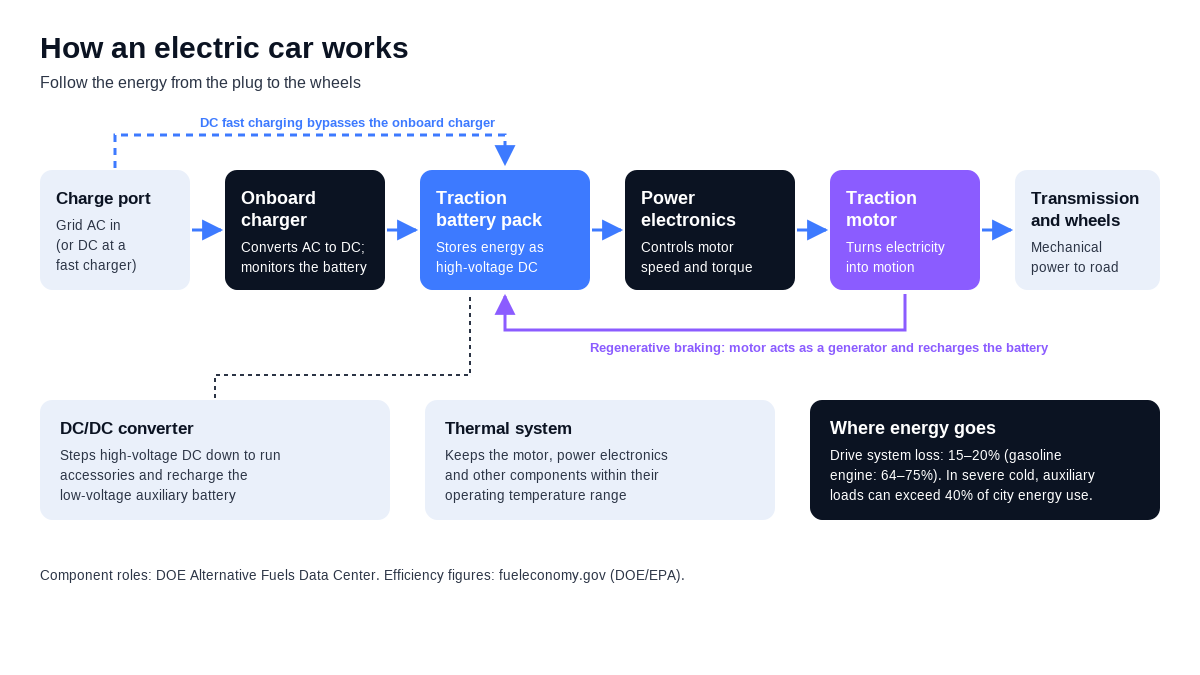
The same principles drive electric cars. See our electric vehicles beginner's guide for the ground-based version.
The energy density problem
Energy per kilogram (specific energy) is the single biggest constraint in electric aviation. Every kilogram an aircraft carries has to be lifted and kept aloft, and unlike fuel, a battery doesn't get lighter as it's used.
A 2023 NASA-published study put the numbers side by side [1]:
Energy source | Raw specific energy | Usable energy after conversion losses |
|---|---|---|
Jet fuel | About 43 MJ/kg (roughly 11,900 Wh/kg) | Around 6,500 Wh/kg, assuming 55% gas-turbine efficiency |
State-of-the-art battery pack (as of 2023) | — | Around 135 Wh/kg at pack level, assuming 90% transmission efficiency |
Even after crediting electric motors with much higher efficiency, jet fuel delivers nearly fifty times more useful energy per kilogram [1]. The NASA authors note that replacing a large share of an airliner's fuel energy with batteries would greatly increase aircraft empty weight [1].
This is why the industry's near-term focus is on small aircraft and short hops, where the trade-off works. Better cells, such as the solid-state designs covered in our solid-state batteries explainer, could widen the envelope, but they are still under development.
The main types of electric aircraft
Type | What it is | Typical mission | Status (as of Nov 2026) |
|---|---|---|---|
Electric trainer / light aircraft | Small fixed-wing plane, battery-powered | Flight training circuits, short local flights | Certified in Europe since 2020 [6]; new US light-sport rules allow electric propulsion [5] |
eVTOL air taxi (powered-lift) | Vertical takeoff and landing with multiple electric rotors, wing-borne cruise | Short urban and regional trips | In FAA type-certification and pilot-program flights [4][7][8] |
Hybrid-electric regional | Combustion engine plus batteries or generator | Regional routes | Development and research stage |
Hydrogen-electric | Fuel cells or hydrogen combustion | Regional, longer term | Research and demonstration |
Electric trainers
On June 10, 2020, the European Union Aviation Safety Agency certified the Pipistrel Velis Electro. It was the first type certification of a fully electric aircraft anywhere in the world [6]. It's a two-seat aircraft intended mainly for pilot training [6], a mission where short, repeated flights near an airport fit battery limits well.
In the US, the FAA's MOSAIC rule was published July 24, 2025. It modernizes the light-sport aircraft category and allows new types of propulsion, including electric [5]. Its airworthiness certification provisions took effect July 24, 2026 [5].
eVTOL air taxis
eVTOLs are the highest-profile part of electric aviation. Most designs take off vertically like a helicopter, then transition to wing-borne flight for efficiency. The FAA classes these aircraft as powered-lift, which it describes as the first completely new category of civil aircraft since helicopters were introduced in the 1940s [2].
How US regulation is catching up
The FAA has built the rules for eVTOLs in several pieces:
- Pilot and operating rules. On October 22, 2024, the FAA issued its final rule on powered-lift pilot qualifications, training and operating requirements, including minimum safe altitudes and visibility [2]. The rule was published in the Federal Register on November 21, 2024. It includes a Special Federal Aviation Regulation that runs for ten years [3].
- Aircraft type certification. Each eVTOL design must earn an FAA type certificate. That means proving the design safe through analysis, ground testing and "for credit" flight tests flown by FAA pilots. Joby Aviation, for example, began flight testing its first FAA-conforming aircraft in March 2026 [7]. In its November 4, 2026 results, it said it had completed a wide range of for-credit testing in the fifth and final stage of FAA type certification [8].
- Early operations. Executive Order 14307, signed June 6, 2025, directed faster integration of eVTOLs and other advanced air mobility aircraft into the national airspace. The FAA's eVTOL Integration Pilot Program (eIPP) implements it [4]. Eight public-private projects spanning 28 states were selected on March 9, 2026. Participants bear their own costs, and flight data flows to the FAA to inform future rules [4]. Joby reported eIPP flights in Texas and Florida, including over Tampa on October 29, 2026 [8].
Benefits
- Lower operating noise than helicopters, a key argument for urban operations (the actual effect depends on the design and how it's flown).
- No in-flight emissions with battery power. Lifecycle emissions depend on how the electricity is generated.
- Fewer moving parts in the propulsion system, which could reduce maintenance, though aviation maintenance rules apply regardless.
- Design freedom from distributed propulsion.
Limitations and risks
- Range and payload are tightly limited by battery weight [1].
- Reserves. Aviation requires energy reserves for diversions and holding. That eats into the usable battery capacity.
- Battery aging and thermal safety. Packs degrade, and a lithium-ion fire in flight is a serious hazard, so designs have to keep a single failing cell from spreading to the rest of the pack.
- Infrastructure. Vertiports and high-power aircraft chargers need sites, grid connections and local approvals.
- Certification timelines have repeatedly slipped across the industry. Treat any company's launch date as a target, not a certainty.
How to read electric aviation news
When you see a new claim, check:
- Is the aircraft certified, in for-credit testing, or just flying prototypes? These are very different stages.
- Is the range figure with reserves and a full passenger load? Brochure ranges often aren't.
- Is it fully electric or hybrid? Many "electric" regional designs rely on a combustion engine for range.
- What rule set applies? Light-sport (MOSAIC) [5], powered-lift [3] and conventional airplane certification each have different requirements.
Outlook
Expect electric aviation to grow from the bottom up: training aircraft, short air-taxi routes and cargo drones first, with larger aircraft depending on battery breakthroughs or hybrid systems. The US regulatory framework for powered-lift is largely in place as of 2026 [2][3][4]. The near-term question is when the first eVTOL designs complete FAA type certification and begin regular paid service in the US. For more on where electric transport is heading on the ground, see the future of electric mobility in America.
Frequently asked questions
Why can't airliners just use batteries like electric cars?
Batteries are far too heavy for the energy they hold. A NASA-published study estimates that jet fuel delivers nearly fifty times more usable energy per kilogram than state-of-the-art battery packs, even after counting electric motors' efficiency advantage [1]. For long flights, that weight penalty is prohibitive with current technology.
What is an eVTOL?
An electric vertical takeoff and landing aircraft. Most use several electric rotors to lift off vertically and then fly on a wing. The FAA calls the category "powered-lift" and finalized pilot and operating rules for it in 2024 [2][3].
Are there any certified electric airplanes?
Yes. EASA certified the two-seat Pipistrel Velis Electro trainer in June 2020, the first fully electric aircraft type certification anywhere [6]. In the US, MOSAIC now allows electric propulsion in light-sport aircraft [5].
When will air taxis start carrying passengers in the US?
There's no fixed date. As of November 2026, eVTOL makers are in FAA type certification. Demonstration flights are happening under the eIPP pilot program, whose projects were selected in March 2026 [4][8]. Regular commercial service depends on completing certification.
Are electric aircraft better for the climate?
They produce no in-flight emissions when battery-powered. Their total climate effect depends on the electricity used to charge them and on battery manufacturing. Today they serve short missions, so their share of aviation emissions is small.
Sources
- Frederick, Z., et al. "Mild Hybrid Electric Propulsion for Single-Aisle Transport Aircraft." AIAA Aviation 2023, NASA Technical Reports Server. https://ntrs.nasa.gov/api/citations/20230005865/downloads/Frederick_Mild_Hybrid_Aviation2023.pdf
- Federal Aviation Administration. "With New Rule, FAA is Ready for Air Travel of the Future." October 22, 2024. https://www.faa.gov/newsroom/new-rule-faa-ready-air-travel-future
- Federal Register. "Integration of Powered-Lift: Pilot Certification and Operations; Miscellaneous Amendments Related to Rotorcraft and Airplanes." Final rule, November 21, 2024. https://www.federalregister.gov/documents/2024/11/21/2024-24886/integration-of-powered-lift-pilot-certification-and-operations-miscellaneous-amendments-related-to
- Federal Aviation Administration. "eVTOL Integration Pilot Program (eIPP)." https://www.faa.gov/aam/eipp
- Federal Aviation Administration. "MOSAIC Fact Sheet." https://www.faa.gov/newsroom/fact_sheets/MOSAIC_Fact_Sheet.pdf
- European Union Aviation Safety Agency. "EASA certifies electric aircraft, first type certification for fully electric plane world-wide." June 10, 2020. https://www.easa.europa.eu/en/newsroom-and-events/news/easa-certifies-electric-aircraft-first-type-certification-fully-electric
- Joby Aviation. "Joby's First FAA-Conforming Aircraft Takes Flight." March 11, 2026. https://ir.jobyaviation.com/news-events/press-releases/detail/176/jobys-first-faa-conforming-aircraft-takes-flight
- Joby Aviation. "Joby Reports Third Quarter 2026 Financial Results." November 4, 2026. https://ir.jobyaviation.com/news-events/press-releases/detail/197/joby-reports-third-quarter-2026-financial-results