The Future of Electric Mobility in America: What the Data Shows
Where US electric mobility stands after the tax credits ended: EV and hybrid sales, charging funds, EIA scenarios and what to watch, as of Nov 2026.
Electric mobility in the US is still growing, but more slowly and along a different path than many forecasts assumed. Federal EV tax credits ended for vehicles acquired after September 30, 2025, and battery-electric vehicles fell to 6% of new light-duty sales in the third quarter of 2026. Hybrids rose to 16% [1][3]. Federal tailpipe greenhouse gas standards were also repealed in February 2026 [5]. Electrification now depends far more on cost, model choice and charging access than on federal policy.
Where things stand (as of November 2026)
Here's the picture from the US Energy Information Administration's latest data [1][2]:
Indicator | Latest figure | Context |
|---|---|---|
Electrified share of new light-duty sales (hybrid + plug-in hybrid + battery-electric), Q3 2026 | 23% | Down slightly from 24% in Q3 2025 |
Hybrid share, Q3 2026 | 16% | Still gaining share, though growth slowed |
Battery-electric share, Q3 2026 | 6% | Down from 10% in Q3 2025 |
Plug-in hybrid share, Q3 2026 | 0.7% | Down from 1.8% |
Battery-electric share, first nine months of 2026 | 6% | Down from 8% in the same period of 2025 |
EVs as share of all registered light-duty vehicles (2024) | 2% | The fleet turns over slowly |
EV electricity use, first half of 2026 | Nearly 14 billion kWh | More than double first-half 2023 |
Two numbers stand out. Battery-electric vehicles hit a record 12% of light-duty sales in September 2025, the month before the credits expired. Then 2025 became the first year in which annual battery-electric sales and market share declined [1]. Meanwhile, hybrids, which never qualified for those credits, kept gaining [1].
If you're weighing the options yourself, our guide to EV vs hybrid vs plug-in hybrid covers the trade-offs.
What changed in federal policy
Three shifts define the new environment:
- Purchase credits ended. The New Clean Vehicle Credit (up to $7,500) isn't available for vehicles acquired after September 30, 2025 [3]. The Qualified Commercial Clean Vehicle Credit for business fleets ended on the same date [7].
- Tailpipe greenhouse gas standards were repealed. EPA finalized the rescission of its 2009 endangerment finding on February 12, 2026. It repealed greenhouse gas standards for light-, medium- and heavy-duty vehicles, so automakers no longer face federal GHG compliance targets that would have pushed EV sales [5].
- Charging-program rules were loosened. The Federal Highway Administration issued revised interim final guidance for the National Electric Vehicle Infrastructure (NEVI) formula program, published August 13, 2025. It rescinds earlier guidance not required by statute, aims to give states more flexibility, and took effect immediately [6].
These changes matter because EIA's long-term outlook depends heavily on them. Its Annual Energy Outlook 2026, released April 8, 2026, shows transportation energy use falling most in cases where the 2024 EPA tailpipe standards for model years 2027–2032 are enforced. Those standards would require significant efficiency gains and more zero-emission powertrains [4]. With those standards repealed, the higher-adoption cases no longer reflect current law.
Why hybrids are winning right now
Hybrids sit in a sweet spot for many US buyers:
- No charging needed. They refuel at gas stations and don't depend on home or public charging.
- Never tied to the credits. Hybrids weren't eligible for the federal credits that expired in September 2025, so buyers lost nothing when they ended [1].
- Price still matters. EIA notes hybrid sales growth slowed in Q3 2026 as the average new-vehicle transaction price passed $50,000 (citing Kelley Blue Book) [1].
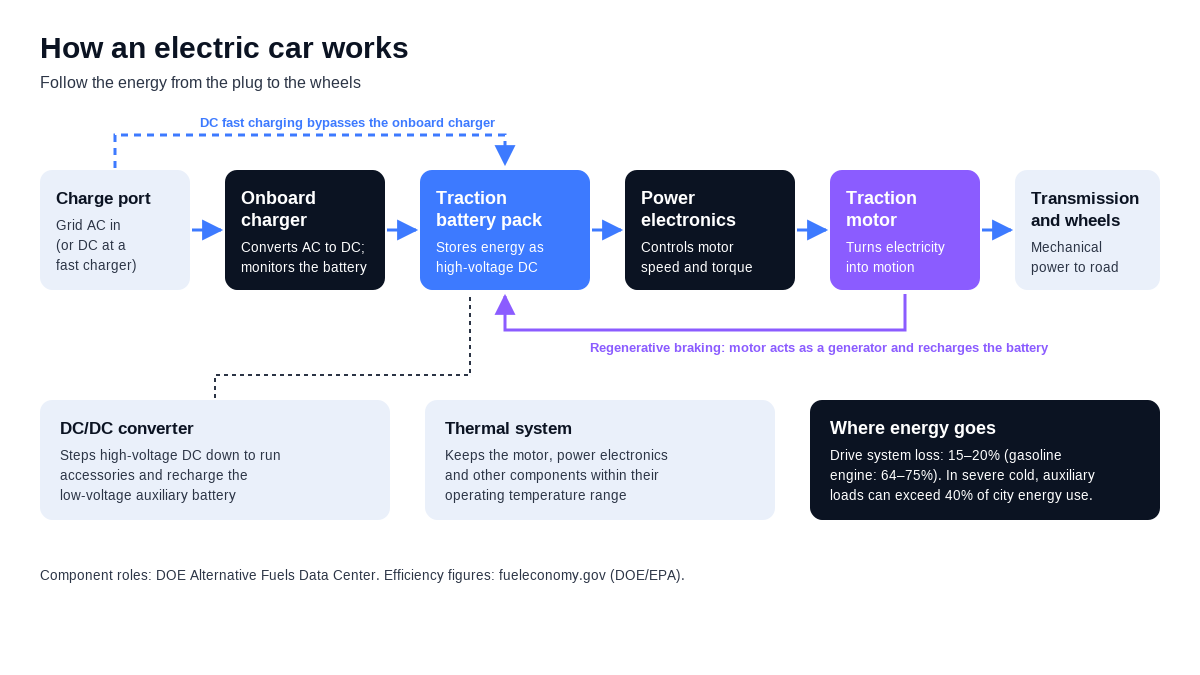
- Meaningful fuel savings in city driving, where regenerative braking recovers energy.
From a grid perspective, EIA notes that hybrids consume liquid fuels and don't connect to the grid, while battery-electric and plug-in hybrid vehicles add to electricity demand [1].
Charging: still the hinge for full EVs
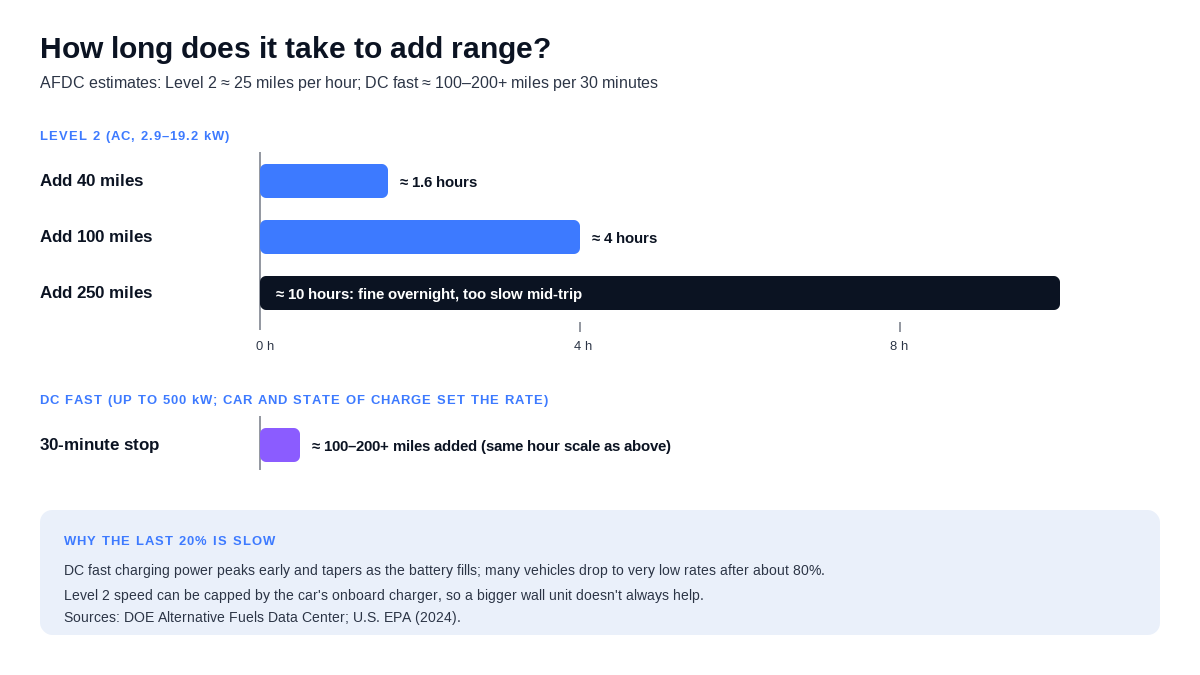
For battery-electric vehicles, convenient charging is a deciding factor. Drivers with a garage or driveway can charge at home on Level 1 or Level 2 equipment. Drivers without one rely on workplace and public charging. Our explainers on EV charging levels and how EV charging networks work cover the infrastructure in more depth.
The revised NEVI guidance lets states keep building federally funded highway chargers under fewer federal requirements, such as letting each state decide the spacing between stations and when its corridors count as built out [6]. How quickly that turns into working stations depends on each state's plan and its contractors.
Beyond passenger cars
Electric mobility in America isn't only about sedans and SUVs:
- Commercial trucks and vans. The federal 45W credit, worth up to $40,000 per vehicle, isn't available for vehicles acquired after September 30, 2025, so fleet electrification now rests on route-by-route economics [7]. See our guide to electric commercial trucks.
- Aviation. Air taxis and other electric and hybrid-electric aircraft are flying test operations under the FAA's three-year eVTOL Integration Pilot Program, which has eight selected projects [8]. See electric aviation technology.
- Vehicles as grid assets. Bidirectional charging could let EVs support homes and the grid. See vehicle-to-grid technology.
Three plausible paths to 2030
These aren't forecasts. They're scenarios built from the drivers above, meant to help you read future news.
Scenario | What would have to happen | Signals to watch |
|---|---|---|
Slow grind | BEV share stays in mid-single digits; hybrids keep growing; few new affordable EV models | BEV share in EIA quarterly data stays near 6% [1] |
Cost-led recovery | Cheaper batteries and new sub-$35,000 EVs restore growth without federal credits | Rising BEV share alongside falling average EV prices |
Policy swing | Future federal or state policy restores purchase incentives or emissions standards | New legislation, rulemakings or court outcomes |
What it means for you
- Buying a car now: Compare total cost of ownership without federal credits. Our line-by-line EV ownership cost guide walks through the math. Check state and utility incentives, which vary widely.
- Choosing between EV and hybrid: If you can charge at home and mostly drive locally, an EV's running-cost advantage is strongest. If you can't charge at home or often drive long distances, a hybrid may fit better.
- Running a fleet: Model each route on its own. Short, predictable duty cycles still favor electric.
Outlook
The long-run direction is still toward more electrified vehicles. In Q3 2026, nearly a quarter of new US light-duty vehicles had some form of electric drive [1]. But the mix has shifted toward hybrids, and full EV adoption is now tied to cost and charging access rather than federal mandates. The EV share of the total fleet was only 2% in 2024 [2], so even fast sales growth takes years to change what's on the road.
Frequently asked questions
Is there still a federal tax credit for buying an EV?
No, not for new purchases. The New Clean Vehicle Credit isn't available for vehicles acquired after September 30, 2025 [3]. Some states and utilities still offer their own rebates.
Are EV sales falling in the US?
Battery-electric sales share fell. It was 6% of new light-duty sales in Q3 2026, versus 10% a year earlier, and 6% for the first nine months of 2026 versus 8% in the same period of 2025 [1]. Total electrified sales including hybrids held near a quarter of the market [1].
Why are hybrid sales growing so fast?
Hybrids don't need charging and save fuel, especially in city driving. They also were never eligible for the expired federal EV credits, so buyers lost nothing when those ended [1].
Is the government still funding EV chargers?
Yes, under revised rules. FHWA's interim final NEVI guidance, published August 13, 2025, lets states continue the formula program with fewer federal requirements [6]. Funding levels and guidance can change, so check your state's NEVI plan for current status.
How much electricity do EVs use in the US?
EIA estimates light-duty EVs used nearly 14 billion kWh in the first half of 2026. That's more than double the first half of 2023, but growth slowed to 8% over the previous six months [2].
Sources
- U.S. Energy Information Administration. "Hybrid sales rise while battery electric sales remain lower after tax credit expiration." Today in Energy, October 19, 2026. https://www.eia.gov/todayinenergy/detail.php?id=68325
- U.S. Energy Information Administration. "U.S. electricity use for electric vehicles increasing at a slower pace in 2026." Today in Energy, September 30, 2026. https://www.eia.gov/todayinenergy/detail.php?id=68224
- Internal Revenue Service. "Credits for new clean vehicles purchased in 2023 or after." https://www.irs.gov/credits-deductions/credits-for-new-clean-vehicles-purchased-in-2023-or-after
- U.S. Energy Information Administration. "Annual Energy Outlook 2026." April 8, 2026. https://www.eia.gov/outlooks/aeo/
- U.S. Environmental Protection Agency. "Final Rule: Rescission of the Greenhouse Gas Endangerment Finding and Motor Vehicle Greenhouse Gas Emission Standards Under the Clean Air Act." https://www.epa.gov/regulations-emissions-vehicles-and-engines/final-rule-rescission-greenhouse-gas-endangerment
- Federal Highway Administration. "National Electric Vehicle Infrastructure Formula Program Guidance." Federal Register, August 13, 2025. https://www.federalregister.gov/documents/2025/08/13/2025-15370/national-electric-vehicle-infrastructure-formula-program-guidance
- Internal Revenue Service. "Commercial Clean Vehicle Credit." https://www.irs.gov/credits-deductions/commercial-clean-vehicle-credit
- Federal Aviation Administration. "The FAA's eVTOL Integration Pilot Program is Advancing Aviation's Next Frontier." Cleared for Takeoff blog, last updated November 2, 2026. https://www.faa.gov/blog/clearedfortakeoff/faas-evtol-integration-pilot-program-advancing-aviations-next-frontier