EV Battery Technology Explained: Cells, Packs, Cooling and Lifespan
How an EV battery is built and managed: cell formats, pack design, the BMS, cooling, 400 V vs 800 V, why fast charging tapers, lifespan, cost and recycling.
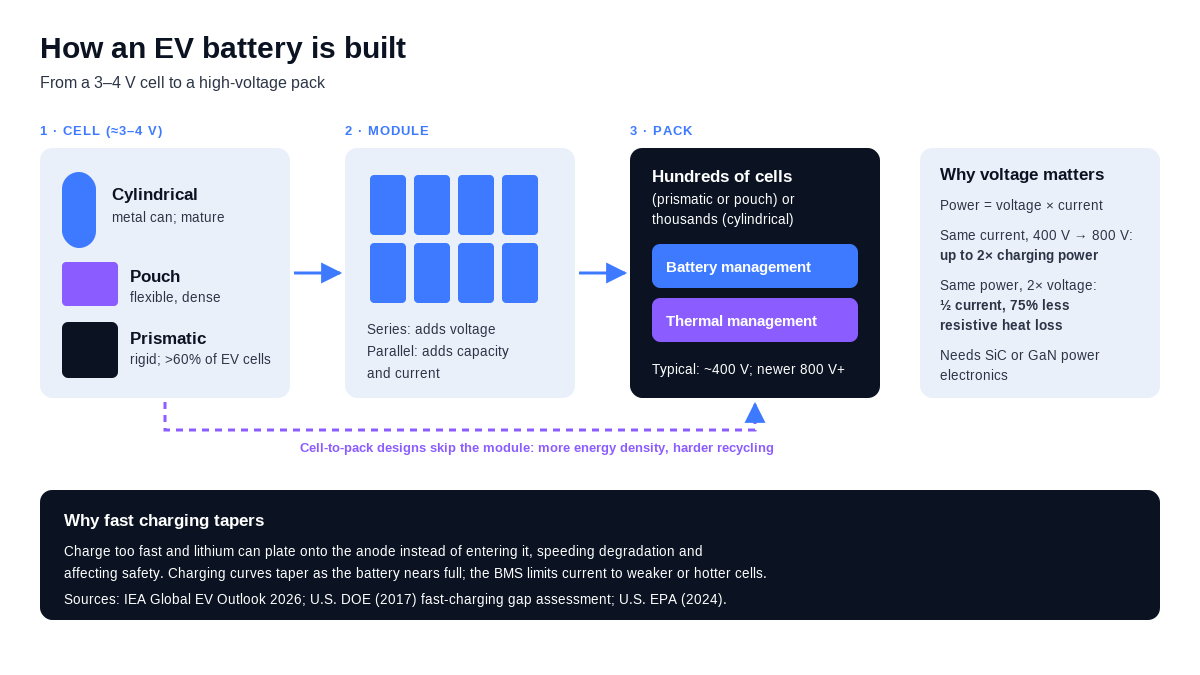
An EV battery is a pack of hundreds to thousands of lithium-ion cells, each around 3 to 4 volts. The cells are wired in series and parallel to reach the pack's working voltage, typically about 400 V, or 800 V and above in newer fast-charging designs [1]. A battery management system and a cooling system keep every cell inside safe limits of voltage and temperature [3][6]. Those engineering choices shape how fast the car charges, how long the battery lasts and what it costs [1][3][4].
Chemistry gets its own guides: see LFP vs NMC batteries and solid-state batteries explained. This article covers how cells become a car battery and how that battery is kept healthy.
From cell to pack
The cell is the basic unit, typically operating at about 3 to 4 V [1]. (Our LFP vs NMC guide explains what happens inside one.)
Modules and packs. Cells are connected in series to raise voltage and in parallel to add capacity. Traditionally, groups of cells form modules, and modules form the pack. A pack contains several hundred cells if they're prismatic or pouch cells, and several thousand if they're cylindrical [1].
Cell-to-pack (CTP) and cell-to-chassis (CTC). Newer designs skip the module stage and place cells directly in the pack, or make the pack part of the car's structure. The IEA notes this raises overall energy density but makes recycling more complicated [1].
The three cell formats
The industry is split across three physical cell "form factors," largely for historical reasons [1]:
Format | What it is | Strengths | Who leans on it (per IEA) |
|---|---|---|---|
Cylindrical | Rolled cells in a metal can; first lithium-ion cells commercialized by Sony in 1991 | Mature manufacturing | Japanese producers [1] |
Pouch | Flat layers in a flexible sealed pouch | High energy density; customizable dimensions | Korean producers, shaped by the smartphone era [1] |
Prismatic | Rigid rectangular case | Compact, stacks efficiently in packs | Chinese producers; over 60% of EV and most stationary batteries [1] |
Prismatic cells have improved quickly. Cooling plates between cells speed up heat removal, and cell-to-pack designs raise density. The IEA says these advances were especially important in bringing LFP batteries into EVs, which today rely almost exclusively on prismatic cells [1].
Chemistry, briefly
Most of today's EVs use lithium-ion batteries, though the exact chemistry often differs from consumer electronics [2]. Two families dominate:
- Nickel-rich chemistries (NMC and similar) offer higher energy density and use relatively small amounts of cobalt [1].
- LFP (lithium iron phosphate) contains no cobalt [1]. In 2025, LFP packs were more than 40% cheaper per kWh on average than NMC. The IEA notes part of that gap reflects stationary storage, which mostly uses LFP and needs less energy density [1].
Sodium-ion batteries are entering the scale-up phase. They perform better at low temperatures and don't use lithium, but have lower energy density, so the IEA expects them to suit shorter-range vehicles first [1].
The battery management system (BMS)
No two cells are perfectly identical. DOE's fast-charging assessment notes that cells can age at slightly different rates, so their capacities drift apart and some end up at a higher state of charge than others after fast charging. Aging can also be non-uniform because of temperature differences or production mismatch [3]. The battery management system (BMS) has to compensate for this during balancing, limit current through weaker or hotter cells and prevent cell overvoltage [3].
During charging, the car's onboard charger also communicates with the charging equipment and monitors battery voltage, current, temperature and state of charge [6]. DOE's gap assessment noted that higher pack voltages, more complex thermal systems and cell balancing during charging may require more complex battery management [3].
Thermal management: heat is the enemy
Heat accelerates battery aging, and charging produces heat; DOE's gap assessment notes that temperatures above 45°C rapidly degrade battery life [3]. The car's thermal system keeps components in their proper operating range [6].
Idaho National Laboratory's study of 2012 Nissan Leaf packs shows why cooling matters. The packs had passive thermal management, with no active cooling. The researchers note that modules placed between other modules run hotter than those near the pack's edges, and that uneven temperatures create uneven aging. The DC fast-charged pack faded significantly faster than individual cells tested under similar charging protocols, which they attribute primarily to temperature [4]. That's why pack design puts so much effort into heat removal. The IEA highlights cooling plates placed between prismatic cells as one recent innovation [1].
Temperature also affects range. In very cold weather, auxiliary loads such as cabin heating can account for more than 40% of energy use in city driving [7].
Voltage: 400 V vs 800 V and beyond
Pack voltage sets a ceiling on charging speed. The IEA explains the physics: at a given current, power is proportional to voltage. Doubling voltage from 400 V to 800 V can double charging power, if the rest of the system allows. At the same power, doubling the voltage halves the current. Resistive heat losses scale with the square of the current, so they fall by 75% [1].
~400 V packs | 800 V+ packs | |
|---|---|---|
Market share | Most EV models today [1] | Growing; more than 30 new high-voltage car models launched globally in 2025 [1] |
Milestones | Long the industry standard [1] | Porsche Taycan (2019) first 800 V; Lucid Air (2021) first 900 V; first 1,000 V models (BYD) in 2025 [1] |
Trade-offs | Long seen as a good compromise between charging performance and pack complexity, cost and reliability [1] | Needs silicon carbide or gallium nitride power electronics; less tolerant of cell defects, so tighter quality control [1] |
Why fast charging slows down: lithium plating
Charging pushes lithium ions into the anode. Push them too fast and they can't slot into the anode's structure in time. Metallic lithium then forms on the surface, a process called lithium plating [3]. DOE's gap assessment says plating can hurt electrode performance, accelerate degradation and affect cell safety [3]. Charging too quickly also raises battery temperature and drives other harmful side reactions [3].
There's a design trade-off here too. Thicker electrodes store more energy, but they need slower charging to avoid plating. Thinner electrodes suit fast charging better but raise cost [3]. In practice, an EPA presentation on fast-charging data notes that charging curves are front-loaded and taper as the battery approaches full, with many current vehicles dropping to very low rates after about 80% [8]. For what this means at the plug, see Level 2 vs DC fast charging.
How long EV batteries last
- Lifespan. Fueleconomy.gov cites a DOE study suggesting EV batteries may last 12 to 15 years in moderate climates and 8 to 12 years in severe climates [5].
- Capacity at end of vehicle life. AFDC notes a battery could still have at least 70% of its initial capacity at the end of its vehicle life, if it hasn't failed or been damaged [2].
- What speeds aging. Heat, fast charging in poorly cooled packs, and cell-to-cell differences that the BMS must work around [3][4].
Replacement can be costly if a battery fails [5], so check the battery warranty terms when buying.
Cost: falling, but unevenly
The IEA reports that over the past decade, average EV pack energy density rose by about 60% while prices fell by roughly 75% [1]. Average battery prices dropped another 8% in 2025 [1]. But regional gaps widened: in 2025, pack prices in China were 30% lower than in North America and 35% lower than in Europe [1].
Minerals could push back. Lithium prices in early 2026 were more than twice those of a year earlier, though still about 70% below their 2022 peak. Cobalt prices doubled after export restrictions by the Democratic Republic of the Congo [1]. For supply-chain angles, see our coverage of Canada's EV battery supply chain and US battery startups.
End of life: second use and recycling
Second life. Many studies have concluded that reusing retired EV batteries in second-use applications is technically feasible, and AFDC says such a battery can continue to work for another 10 years or more. The economic viability of installing second-life batteries is still evolving [2].
Recycling. Recycling starts by mechanically shredding packs into "black mass." AFDC describes three recovery routes [2]:
Method | How it works | Notes |
|---|---|---|
Smelting (pyrometallurgy) | High-temperature furnace recovers metals and salts | Operates at large scale and accepts many battery types; lithium ends up in slag; energy-intensive [2] |
Chemical leaching (hydrometallurgy) | Acids or other solutions dissolve metals from black mass | Recovers lithium compounds; lower capital cost; many US and global companies are building facilities [2] |
Direct recycling | Recovers cathode material while keeping its molecular structure | Potentially the most economical; still developing [2] |
AFDC also notes that design-for-disassembly and standardized cells would make recycling easier and cheaper [2]. That's a tension with cell-to-pack designs, which the IEA says complicate recycling [1].
What to check when buying
- Usable capacity (kWh) and efficiency, not just the headline range.
- Chemistry. LFP and nickel-rich packs behave differently with charging and cold weather. See our LFP vs NMC guide.
- Pack voltage and peak charging power, if you road-trip often [1].
- Thermal management. Ask whether the pack is actively cooled [4].
- Battery warranty terms for years, miles and the capacity threshold.
Frequently asked questions
How many cells are in an EV battery?
Several hundred if the pack uses prismatic or pouch cells, and several thousand with smaller cylindrical cells, according to the IEA [1]. Each cell typically operates at about 3 to 4 volts [1].
What does a battery management system do?
It watches cell voltages and temperatures, compensates for cells that age unevenly, prevents cell overvoltage and limits current through weaker or hotter cells [3]. DOE expects higher-voltage packs and faster charging to need more advanced BMS designs [3].
Is an 800-volt EV better?
It can charge faster. At the same current, doubling voltage doubles power, and at the same power it cuts heat losses by 75% [1]. It needs more advanced power electronics and tighter cell quality control, and most models still use about 400 V [1].
How long does an EV battery last?
A DOE study cited by fueleconomy.gov suggests 12 to 15 years in moderate climates and 8 to 12 years in severe climates [5]. Batteries often keep at least 70% of their capacity at the end of vehicle life [2].
Can EV batteries be recycled?
Yes. Smelting, chemical leaching and direct recycling can recover valuable materials. Smelting already operates at large scale, and many US and global companies are building hydrometallurgy facilities [2].
Sources
- International Energy Agency. "Global EV Outlook 2026." May 2026. https://www.cleanenergyministerial.org/content/uploads/2026/05/globalevoutlook2026.pdf
- U.S. Department of Energy, Alternative Fuels Data Center. "Batteries for Electric Vehicles." https://afdc.energy.gov/vehicles/electric-batteries
- Howell, D., et al. "Enabling Fast Charging: A Technology Gap Assessment." U.S. Department of Energy, October 2017. https://www.energy.gov/sites/prod/files/2017/10/f38/XFC%20Technology%20Gap%20Assessment%20Report_FINAL_10202017.pdf
- Tanim, T. R., Shirk, M. G., Bewley, R. L., Dufek, E. J., Liaw, B. Y. "Fast charge implications: Pack and cell analysis and comparison." Idaho National Laboratory, INL/JOU-17-43278; Journal of Power Sources 381 (2018). https://inldigitallibrary.inl.gov/sites/sti/sti/Sort_3282.pdf
- fueleconomy.gov (DOE/EPA). "All-Electric Vehicles." https://www.fueleconomy.gov/feg/evtech.shtml
- U.S. Department of Energy, Alternative Fuels Data Center. "How Do All-Electric Cars Work?" https://afdc.energy.gov/vehicles/how-do-all-electric-cars-work
- fueleconomy.gov (DOE/EPA). "Where the Energy Goes: Electric Cars." https://www.fueleconomy.gov/feg/atv-ev.shtml
- Sobel, A. "DC Fast Charging Information for Consumers." U.S. Environmental Protection Agency, Office of Transportation and Air Quality, presentation, May 30, 2024. https://www.epa.gov/system/files/documents/2024-06/mstrs-spr-mtg-dc-fast-chrg-consumer-info-2024-05-30.pdf