Tesla NACS (J3400) vs CCS1: The US Charging Plug Switch Explained
NACS (SAE J3400) vs CCS1 compared: plug design, ratings, Supercharger access, adapters and the 2025–2027 switch, with what it means for EV buyers today.
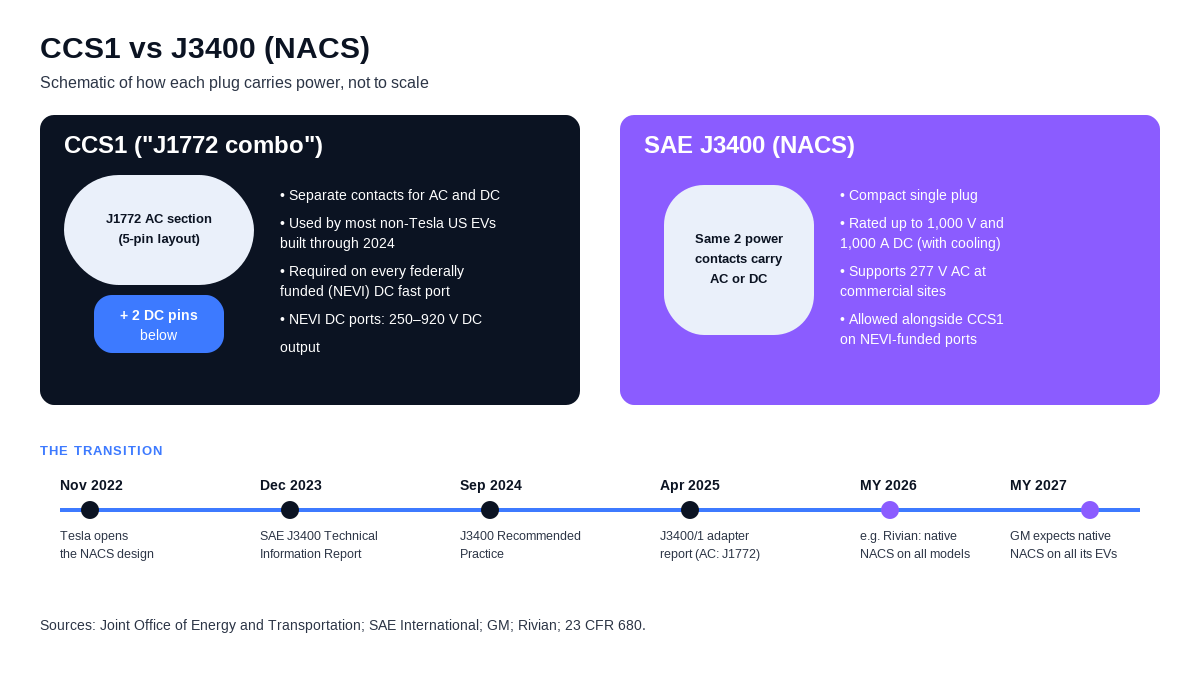
NACS is the plug Tesla designed, and SAE has now standardized it as J3400. CCS1 is the plug most other US EVs have used for DC fast charging. J3400 is smaller and carries both AC and DC power through the same two contacts. CCS1 bolts two extra DC pins onto the older J1772 AC plug [1][3]. As of late 2026, US automakers are moving their new models to native J3400 ports, so the practical question for drivers is which port your car has and which adapter you need [1][7][8].
For the basics of charging levels and connectors, see our EV charging levels explainer. For everything behind the plug, from communication protocols to federal rules, see EV charging standards in the United States. This article focuses on the plug transition itself.
How Tesla's plug became an industry standard
- November 2022: Tesla renamed its previously proprietary connector the North American Charging Standard (NACS) and opened the design to other manufacturers in North America [1].
- June 2023: SAE International announced it would standardize NACS. Its task force had more than 120 public- and private-sector experts [1].
- December 2023: SAE published J3400 as a Technical Information Report [1][3].
- September 2024: SAE revised J3400 as a Recommended Practice (J3400_202409), a format that can be cited in regulations [1][3].
- April 2025: SAE issued J3400/1 on adapter safety. Its first edition covers only adapters between J3400 and J1772 (AC) [4].
The Joint Office of Energy and Transportation summed up the immediate effect: opening the standard gave more EVs access to Tesla's Supercharger network [2].
J3400 vs CCS1: the technical differences
CCS1 ("J1772 combo") | J3400 (NACS) | |
|---|---|---|
Origin | Industry standard built on SAE J1772 | Tesla design, standardized by SAE [1] |
How AC and DC are carried | The J1772 five-pin layout for AC, plus two additional DC pins below [1][5] | The same two current-carrying contacts carry either DC or single-phase AC [3] |
Layout | AC section with a separate DC section below it [1] | Compact single plug; CharIN survey respondents cite its compact design as a benefit [6] |
Rated DC capability | Depends on equipment; federally funded DC ports must output 250–920 V DC [9] | Rated for up to 1,000 V and 1,000 A DC with adequate cooling [2] |
AC charging | Level 1 and 2 through the J1772 section [5] | Level 1 and 2 through the same contacts; also supports 277 V AC supply at commercial sites [2] |
Safety certification | UL standards for EV equipment [9] | UL 2251 for connectors and cables; UL 2252 for adapters [1][2] |
Federal funding rules | Required on every NEVI-funded DC port [9] | Allowed alongside CCS1 [1][9] |
Two details matter for the longer term. First, J3400's ability to accept 277 V AC could cut the cost of AC charging at commercial sites that already have 480 V three-phase power [2]. Second, the Joint Office notes J3400 opens the door to vehicle-to-grid energy transfer and "bring-your-own-cord" charging [2].
What doesn't change: the "language" of charging. The plug is only the physical layer. Charger and car still need to agree on communication. CharIN, the charging industry group, set up its North America Charging Interoperability task force to keep charging connector-agnostic under the ISO 15118 and DIN SPEC 70121 protocols, so the same communication standards apply whichever plug a car uses [2].
Where the transition stands (as of late 2026)
Automakers. The Joint Office reported that all major automakers and charging companies had announced plans to adopt J3400, from as early as 2025. It also noted that every non-Tesla EV produced through 2024 kept a CCS1 port [1]. Concrete examples:
- GM: Cadillac Optiq (2026) and the new Chevrolet Bolt (sold as a 2027 model) have native NACS ports. GM expects all 2027 model year Cadillac, Chevrolet and GMC EVs to come with NACS ports as standard. Most 2026 GM EVs still have CCS ports and need an adapter for Superchargers [7].
- Rivian: All vehicles from model year 2026 onward are built with a native NACS port. Rivian-approved adapters are used for CCS1 or J1772 chargers [8].
- Industry-wide: In January 2026, CharIN cited preliminary data that roughly one in five non-Tesla EVs sold already had native NACS inlets, led by Hyundai, Kia, Genesis and Rivian. It expects native compatibility to become the norm within about two model years [6].
For one example of a new model launching with NACS charging, see our coverage of the 2026 Toyota C-HR EV.
Chargers. CharIN reports Tesla has more than 34,000 US fast-charging ports, most now open to non-Tesla vehicles through adapters or native ports. Other networks, including Mercedes-Benz, BP Pulse and Walmart Energy, have begun deploying dual CCS/NACS dispensers [6].
Federal rules. NEVI-funded DC fast ports must still be able to charge any CCS1 vehicle and carry a permanently attached CCS1 connector. A J3400 connector can be added alongside [1][9]. The Joint Office says adapters on federally funded chargers must be permanently attached and integrated by the charger manufacturer [1]. As of November 2026, eCFR still shows the 2023 rule's CCS1 requirement in force [9].
Adapters: what's safe and what isn't
During the transition, both port types will be common on the road, so many drivers will need an adapter at some point [2].
- Use automaker-approved or UL 2252 certified adapters. The Joint Office's adapter page still advises that, until UL 2252 certified adapters become available, drivers should use only adapters provided by their vehicle manufacturer for their specific vehicle, because not all adapters work with all models or chargers [2]. That guidance is now dated: UL 2252, the safety standard for EV coupler adapters, was published in March 2025 and revised in June 2026 [10], and adapter makers have since announced UL 2252 certified products. Lectron, for example, says its full adapter lineup, AC and DC, has passed UL 2252 testing (as of February 2026) [11]. Even with a certified adapter, check that your automaker supports it for your model.
- Know the direction. CCS1-port cars need a J3400-to-CCS1 adapter for Tesla-style chargers. Native-NACS cars need the reverse to use CCS stations. GM, for example, states that a native-NACS GM EV needs a NACS-to-CCS adapter at a CCS station [7].
- Built-in adapters exist too. Tesla's Magic Dock is an attached NACS-to-CCS1 adapter that lets non-Tesla CCS cars plug in at Supercharger stations equipped with it [1].
- AC adapters are a separate case. SAE's J3400/1 adapter report currently covers only J3400 to J1772 [4]. Tesla vehicles come with a J1772 adapter for non-Tesla Level 2 equipment [5].
What it means for you
Buying a new EV in late 2026. Check the port. A native J3400 port gives direct Supercharger access. Confirm the automaker includes or sells a CCS1 adapter for the many CCS-only stations still in service.
Owning a CCS1 car. Nothing stops working. CCS1 stays mandatory on federally funded fast chargers [9]. If you want Supercharger access, buy the adapter your automaker approves, and check in the automaker's app which stations your car can use.
Installing home charging. Level 2 equipment has traditionally used the J1772 plug. J3400 cars can use it through an adapter (every Tesla comes with one), and J3400 cars can also use J3400 chargers at home [5]. If your household might mix vehicles, consider which plug you'll need over the next several years.
Site hosts and fleets. Dual-connector dispensers serve both groups. The CCS1 connector remains required for NEVI funding [9].
Outlook
Expect the next two model years to finish most of the vehicle-side switch, based on CharIN's estimate and GM's 2027 plan [6][7]. CCS1 cars will stay on the road for many years after that, so CCS1 connectors and adapters won't disappear quickly. One open policy question: in 2024, FHWA and the Joint Office asked for input on J3400 market readiness and possible performance-based standards for federally funded chargers [1]. As of late 2026, the federal rule still centers on CCS1 [9]. Watch for any change to that requirement.
Frequently asked questions
Is NACS the same as J3400?
Essentially, yes. J3400 is SAE's standardized version of Tesla's NACS connector, published as a Technical Information Report in December 2023 and revised as a Recommended Practice in September 2024 [1][3]. "NACS" is still widely used as the everyday name.
Can my CCS car use a Tesla Supercharger?
Often, yes, with an approved adapter, or at a Supercharger station equipped with Tesla's Magic Dock attached connector [1][2]. Check your automaker's app for which sites are compatible with your car. Use only the adapter your automaker approves [2].
Is J3400 faster than CCS1?
The connector itself isn't what usually limits speed. J3400 is rated for up to 1,000 V and 1,000 A DC with adequate cooling [2]. Actual charging speed depends on the car's battery and charging system and on the station, as with any DC fast charging [5].
Will CCS1 chargers disappear?
Not soon. Federally funded DC fast ports must still carry a CCS1 connector as of late 2026 [9], and every non-Tesla EV built through 2024 has a CCS1 port [1].
Are third-party adapters safe?
Look for an adapter your automaker approves or one certified to UL 2252, the adapter safety standard published in March 2025 [10]. The Joint Office's older guidance recommends automaker-provided adapters for your specific vehicle, because not all adapters work with all vehicles or chargers [2].
Sources
- Joint Office of Energy and Transportation. "SAE J3400 Charging Connector." https://driveelectric.gov/charging-connector
- Joint Office of Energy and Transportation. "Electric Vehicle Charging Connector and Adapter Compatibility." https://driveelectric.gov/adapter-compatibility
- SAE International. "J3400_202409: North American Charging System (NACS) for Electric Vehicles." Recommended Practice, revised September 2024. https://saemobilus.sae.org/standards/j3400_202409-north-american-charging-system-nacs-electric-vehicles
- SAE International. "J3400/1_202504: Electric Vehicle Charging Adapter Safety and OEM-Qualified Device Designation." Information Report, April 2025. https://saemobilus.sae.org/standards/j34001_202504-electric-vehicle-charging-adapter-safety-oem-qualified-device-designation
- U.S. Department of Energy, Alternative Fuels Data Center. "Developing Infrastructure to Charge Electric Vehicles." https://afdc.energy.gov/fuels/electricity-stations
- CharIN. "The shift to NACS: What it means for the future of EV charging in North America." January 16, 2026. https://www.charin.global/news/the-shift-to-nacs-what-it-means-for-the-future-of-ev-charging-in-north-america/
- General Motors. "Every GM electric vehicle with NACS charging." August 2026. https://news.gm.com/home.detail.html/Pages/topic/us/en/2026/aug/0813-electric-vehicle-nacs-charging.html
- Rivian. "What is NACS?" https://rivian.com/support/article/what-is-nacs
- Federal Highway Administration. 23 CFR Part 680, "National Electric Vehicle Infrastructure Standards and Requirements," via eCFR. https://www.ecfr.gov/current/title-23/chapter-I/subchapter-G/part-680
- UL Standards & Engagement. "UL 2252: Adapters for Use with Electric Vehicle Couplers." Edition 1, March 19, 2025; revised June 24, 2026. https://www.shopulstandards.com/ProductDetail.aspx?productId=UL2252
- Charged EVs. "Lectron's full EV charging adapter lineup earns UL 2252 certification." February 19, 2026. https://chargedevs.com/newswire/lectrons-full-ev-charging-adapter-lineup-earns-ul-2252-certification