The Future of Cloud Infrastructure: Power, Chips and Sovereignty
Where cloud infrastructure is heading: AI-driven power demand, nuclear deals, liquid cooling, rack-scale systems, custom chips and sovereign cloud.
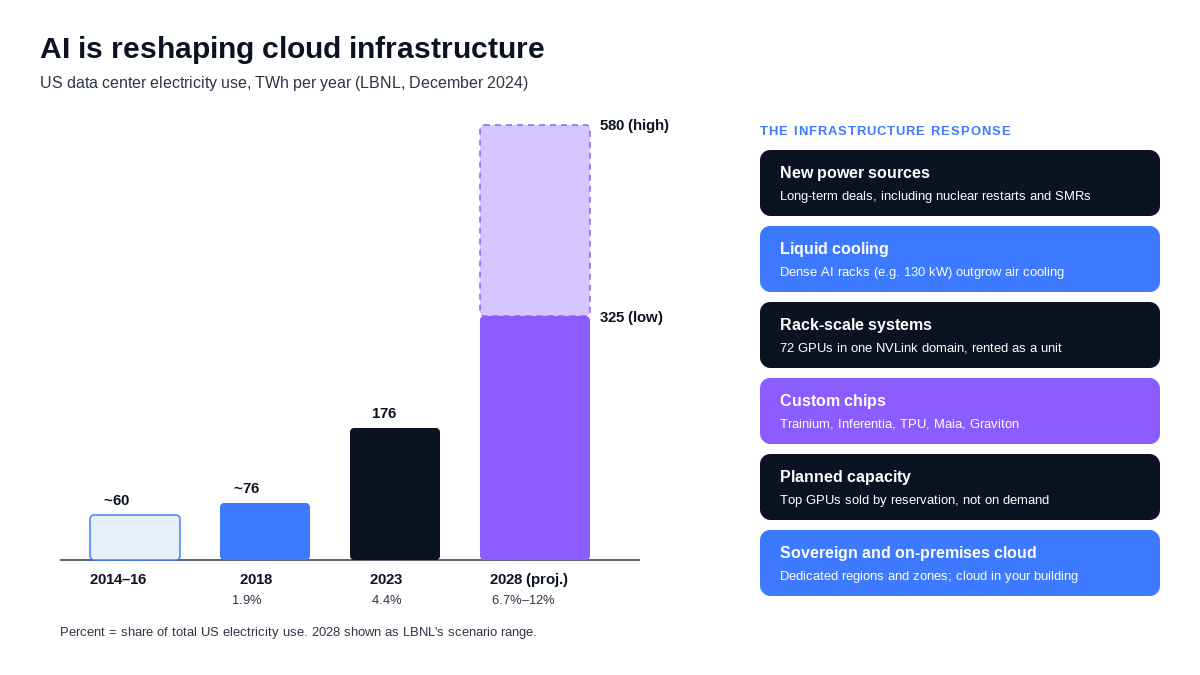
AI is pushing cloud infrastructure in a new direction. For roughly a decade, efficiency gains held US data center electricity use nearly flat while the industry grew. That ended around 2017, when GPU-accelerated AI servers started driving consumption back up [1]. Lawrence Berkeley National Laboratory (LBNL) projects US data centers could use 6.7% to 12% of the country's electricity by 2028 [1]. The documented responses are reshaping the cloud from the power plant up: new power deals including nuclear, liquid cooling, rack-scale AI systems, custom chips, reservation-based capacity, and sovereign or on-premises cloud deployments [2][3][5][6][7][10].
This is an analysis of trends, not a forecast. Anything forward-looking below is labeled as an expectation and attributed. For the basics, see what cloud computing is and cloud computing for AI workloads.
Trend 1: power becomes the limiting resource
LBNL's 2024 report for DOE gives the clearest US numbers [1]:
Year | US data center electricity use | Share of US electricity |
|---|---|---|
2014–2016 | ~60 TWh (stable) | — |
2018 | ~76 TWh | 1.9% |
2023 | 176 TWh | 4.4% |
2028 (projected range) | ~325–580 TWh | 6.7%–12.0% |
At an average 50% capacity utilization, the 2028 range translates to 74 to 132 GW of data center power demand [1]. The wide range reflects real uncertainty: how many GPUs get shipped, how intensively they're used, and which cooling systems operators choose [1].
The history matters. LBNL notes that in the early and mid-2010s, the shift from on-premises data centers to colocation and cloud facilities helped keep electricity use nearly constant while the industry grew. That came from better cooling and power management, higher server utilization and lower idle power [1]. AI broke that pattern because the new workloads are so compute-intensive.
What it means: new cloud regions increasingly follow available power rather than just customer proximity. Expect power and grid timelines to shape where and how fast capacity appears.
Trend 2: cloud companies become energy buyers, including nuclear
Large cloud providers are signing long-term deals for round-the-clock carbon-free power:
- Microsoft and Constellation (September 2024). A 20-year power purchase agreement to restart Three Mile Island Unit 1 as the Crane Clean Energy Center, adding about 835 MW. Constellation said it expected the plant online in 2028, subject to Nuclear Regulatory Commission approval [2].
- Google and Kairos Power (October 2024). Google called it the world's first corporate agreement to buy nuclear energy from multiple small modular reactors (SMRs). The plan targets a first reactor by 2030, with additional deployments through 2035, for up to 500 MW of new 24/7 carbon-free power in total [3].
- Amazon (October 2024). Agreements including four SMRs with Energy Northwest in Washington (about 320 MW initially, with an option for 960 MW), an investment in reactor developer X-energy, and an SMR exploration with Dominion Energy in Virginia [4].
These are agreements for future projects, most of which depend on regulatory approvals and construction. Treat dates as company targets. For how small reactors work, see our explainer on small modular nuclear reactors.
Trend 3: liquid cooling and much denser racks
AI accelerators pack far more power into each rack than traditional servers, and air cooling struggles to keep up:
- CoreWeave advertises liquid-cooled GPU infrastructure ready to support 130 kW of rack power [8].
- Microsoft built rack-level, closed-loop liquid cooling for its Maia 100 accelerators. That lets it fit Maia systems into existing data centers within the existing footprint [5].
- LBNL treats the shift to liquid cooling, and away from evaporative cooling, as one of the key variables in its energy scenarios. It describes IT liquid cooling as an emerging technology for dense equipment such as AI hardware [1].
What it means: facilities built for air-cooled servers may need retrofits. Cooling choices also matter for water: LBNL's scenarios include moving away from evaporative cooling [1].
Trend 4: the rack becomes the computer
The unit of AI infrastructure is moving from the server to the whole rack:
- AWS's P6e-GB200 UltraServers put up to 72 NVIDIA Blackwell GPUs in one NVLink domain, delivering up to 360 petaflops of FP8 compute [6].
- Google Cloud's A5X machines are built on NVIDIA's Vera Rubin NVL72 platform and are available as bare metal [7].
Customers increasingly rent these as whole systems through reservations rather than as individual virtual machines. That's a big change from the original cloud promise of small, interchangeable units on demand.
Trend 5: custom silicon everywhere
Each hyperscaler now designs its own chips alongside buying NVIDIA and AMD hardware:
Company | Custom chips (as of November 2026) |
|---|---|
AWS | Trainium2 for training and inference; Inferentia2 for inference [6]; Graviton general-purpose CPUs, used by over 120,000 AWS customers [9] |
Cloud TPUs, including TPU7x, the first Ironwood-family (seventh-generation) TPU [12] | |
Microsoft | Azure Maia 100, its first in-house AI accelerator, made on a 5 nm process [5] |
The motive is control over cost, supply and performance for each company's own largest workloads. Microsoft says Maia's design was informed by running workloads like Copilot [5]. The trade-off for customers is more choice, but software ecosystems that differ by cloud. Google TPUs, for instance, require code compiled with the XLA compiler [11]. See AI chips vs CPUs vs GPUs vs TPUs.
Trend 6: capacity is planned, not just provisioned
The cloud's classic model of unlimited capacity on demand doesn't hold for frontier hardware. Google says unreserved on-demand capacity isn't available for its A5X, A4X Max, A4X, A4 and A3 Ultra machine types. For A5X, A4X Max and A4X, future reservations for capacity blocks are the only supported option [7].
Specialist AI clouds have grown up around this scarcity. CoreWeave cites a fleet across more than 40 data centers with "gigawatts of contracted power" [8]. Expect AI capacity to keep looking more like a planned, contracted resource than a utility you switch on. Our guide to GPU cloud providers covers how to buy it.
Trend 7: sovereignty and cloud in your own building
Governments and regulated industries want control over where data lives and who operates the systems. Providers are responding with new deployment models. AWS, for example, describes three [10]:
- AWS European Sovereign Cloud: an independent cloud for Europe designed for data residency, operational autonomy and resiliency requirements.
- Dedicated Local Zones: AWS-managed infrastructure built for one customer or community and placed in a location they specify.
- "AI Factories": the customer provides a data center and power, and AWS deploys dedicated, fully managed AI infrastructure there.
The line between public cloud and on-premises keeps blurring. The cloud operating model increasingly comes to the data, not only the other way around. Physical risk is also part of the resilience picture; see our report on conflict damage to cloud infrastructure.
What this means for organizations using the cloud
- Plan AI capacity like a procurement project. Reservations and contracts matter for top-end hardware [7].
- Expect energy to show up in pricing and siting. Power is the new bottleneck [1].
- Weigh custom chips for steady workloads, but budget for software portability [5][6][11][12].
- Review sovereignty needs early. New deployment options exist, but they shape architecture [10].
- Don't over-build. Serverless, managed APIs and smaller models avoid much of this complexity. See serverless computing.
What to watch
- Actual versus projected demand. Will US data center use land nearer the low (325 TWh) or high (580 TWh) end of LBNL's 2028 range [1]?
- Nuclear timelines. Watch for regulatory approvals and construction milestones on the Crane restart and the first SMR projects [2][3][4].
- Cooling and water. How fast liquid cooling spreads and how it changes water use [1].
- Chip competition. Whether custom accelerators take meaningful share from merchant GPUs.
- Sovereign cloud adoption in Europe and in regulated US sectors [10].
Frequently asked questions
How much electricity do data centers use in the US?
LBNL estimates US data centers used 176 TWh in 2023, about 4.4% of US electricity. It projects 325 to 580 TWh by 2028, which would be 6.7% to 12% of forecast consumption [1].
Why are cloud companies investing in nuclear power?
They want large amounts of carbon-free power available around the clock. Microsoft signed a 20-year agreement to restart Three Mile Island Unit 1 [2], Google agreed to buy power from Kairos Power's planned SMRs [3], and Amazon signed agreements supporting several SMR projects [4]. Most of these projects are years from operation.
What is liquid cooling in data centers?
It means removing heat with liquid instead of air, often directly at the rack or chip. It handles the dense heat of AI accelerators better. Examples include Microsoft's closed-loop liquid cooling for Maia 100 racks and CoreWeave's 130 kW liquid-cooled racks [5][8].
Will the cloud still be "on demand" in the future?
For most services, yes. For the newest AI hardware, it's increasingly reservation-based. Google, for instance, offers its top GPU systems only through capacity reservations [7].
What is a sovereign cloud?
A cloud deployment designed so data stays in a region and operations are controlled locally to meet legal requirements. The AWS European Sovereign Cloud is one example, designed for European data residency and operational autonomy [10].
Sources
- Shehabi, A., et al. "2024 United States Data Center Energy Usage Report." Lawrence Berkeley National Laboratory, December 2024. https://eta-publications.lbl.gov/sites/default/files/2024-12/lbnl-2024-united-states-data-center-energy-usage-report_1.pdf
- Constellation Energy. "Constellation to Launch Crane Clean Energy Center, Restoring Jobs and Carbon-Free Power to The Grid." September 20, 2024. https://www.constellationenergy.com/news/2024/Constellation-to-Launch-Crane-Clean-Energy-Center-Restoring-Jobs-and-Carbon-Free-Power-to-The-Grid.html
- Google. "Google signs advanced nuclear clean energy agreement with Kairos Power." October 14, 2024. https://blog.google/outreach-initiatives/sustainability/google-kairos-power-nuclear-energy-agreement/
- Amazon. "Amazon enlists nuclear small modular reactors in push for net carbon-zero." October 16, 2024. https://www.aboutamazon.com/news/sustainability/amazon-nuclear-small-modular-reactor-net-carbon-zero
- Microsoft Azure Blog. "Azure Maia for the era of AI: From silicon to software to systems." https://azure.microsoft.com/en-us/blog/azure-maia-for-the-era-of-ai-from-silicon-to-software-to-systems/
- Amazon Web Services. "Amazon EC2 Accelerated Computing instances." https://aws.amazon.com/ec2/instance-types/accelerated-computing/
- Google Cloud. "GPU machine types" (Compute Engine documentation). https://docs.cloud.google.com/compute/docs/gpus
- CoreWeave. "GPU Compute." https://www.coreweave.com/products/gpu-compute
- Amazon Web Services. "AWS Graviton Processor." https://aws.amazon.com/ec2/graviton/
- Amazon Web Services. "European Digital Sovereignty." https://aws.amazon.com/compliance/europe-digital-sovereignty/
- Google Cloud. "Introduction to Cloud TPU." https://docs.cloud.google.com/tpu/docs/intro-to-tpu
- Google Cloud. "TPU7x (Ironwood)." https://docs.cloud.google.com/tpu/docs/tpu7x